Rate hikes are coming as Australians just aren't getting the RBA's message
Data last week showed stubbornly high inflation and consumers spending freely – taken together, they’re fuel for further RBA rate hikes.

Source: iStock
KEY POINTS
- Household spending rose 1.1% in July, almost four times the 0.3% forecast, and inflation data also came in hotter than expected.
- Money markets have all but priced in a November rate hike, and there's a growing probability that another will follow early next year.
- This article examines how last week's economic data drove the market to price in another RBA interest rate hike by Christmas, and what to watch from here.
The RBA lifted the cash rate 75 basis points across the first half of this year to slow demand. “The domestic economy continues to operate above capacity," said Reserve Bank governor Michele Bullock at the August 11 press conference.
This week, data from the Australian Bureau of Statistics (ABS) showed that household spending has now risen for three months straight, with July's 1.1% jump almost four times what economists expected.
The July spending figures landed a day after CPI data showed underlying inflation still running hot, with the trimmed mean in July at 3.6% p.a. and the headline rate at 3.5% p.a., both above the RBA's 2-3% p.a. target band. The two prints have pushed money markets to all but price in a +0.25% p.a. November rate hike.
Speaking after the August meeting, Ms Bullock said the board would raise again if needed, adding that she personally thought it was quite possible they would have to. It’s a sentiment that was echoed by Deputy governor Andrew Hauser a week later, when he said the RBA would have to raise interest rates again if the upside risks to inflation crystallised and inflation did not come down.
The economic data since, suggests Australians aren’t getting the RBA’s message of constraint. This article examines how we got to this point and what is still to come before the RBA meets again in September.
Inflation is stuck and spending is rising
The RBA’s main focus is keeping inflation between 2% and 3% p.a., and its primary tool is the cash rate. Higher rates make borrowing more expensive, encouraging households and businesses to spend less. Less demand means less pressure on prices – which is why the cash rate has risen so sharply this year.
Reporting season has dominated investors’ attention in August, but a run of macro data has been building in the background. It started with two prints that looked like the RBA’s medicine was working:
The June quarter wage price index, released on 19 August, showed annual growth of 3.2%, with the private sector at 3.1%, its slowest pace since June 2022. Just 10% of private sector jobs recorded any wage rise at all, the lowest share since June 2020.
The jobless rate rose to 4.5% in July from 4.4% in June, with employment down 16,000, hours worked down 0.6%, and the participation rate down 0.2% – all signs of a slowing labour market. However, a solid improvement in full time employment (the fall came almost entirely from part time work), pointed to a labour market that is cooling only gradually.
Bullock has previously described the rise in unemployment as evidence policy was working rather than a sign it had gone too far. Markets were reading it the same way and were not factoring a rate hike to 4.6%p.a. any time in the future.
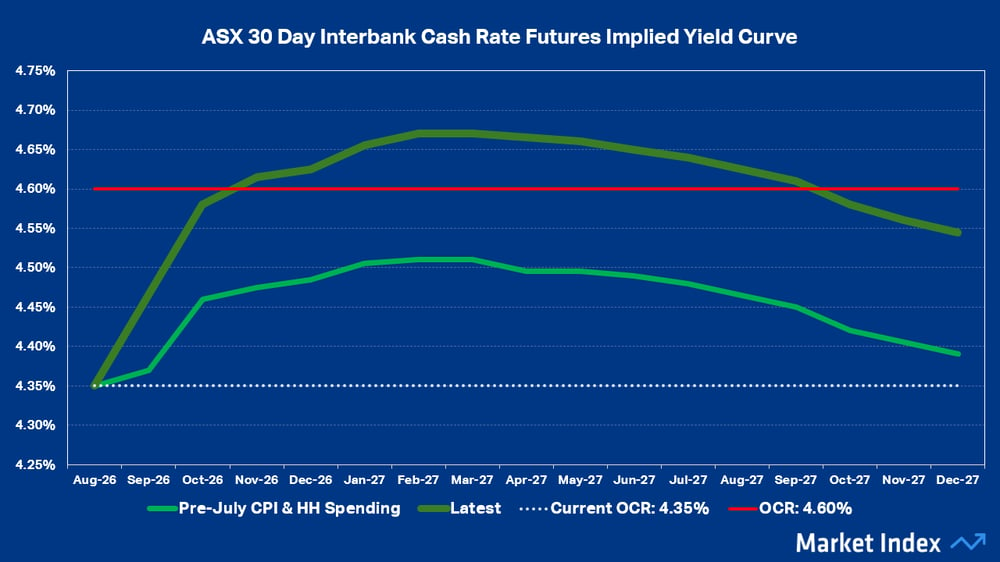
The ASX 30-day interbank cash rate futures curve shows where traders expect the cash rate to sit at the end of each month. In the chart below, we can see the market’s expectation for the RBA cash rate until the end of next year. The light green line is a snapshot taken before this week’s economic data was released. It peaks at 4.51% p.a. in March, suggesting a 64% probability of a 0.25% p.a. hike from the current 4.35% p.a. by that month’s RBA Board meeting.
Source: ASX, Market Index data.
November rate hike near-certain
Two critical pieces of economic data hit last week to dramatically shift the market’s thinking on interest rates. First, The trimmed mean of the consumer price index (CPI), the measure the RBA watches, held at 3.6% p.a. and well above the target band. The next morning, household spending figures showed why, as they came in well above forecasts and were rising across every category. Together they show Australians aren't getting the RBA’s message to slow spending.
The market now predicts a cash rate of 4.58% p.a. for November, putting the odds of a hike by that month’s Board meeting at about 92%. The curve does not stop there, a full 0.25% p.a. Increase is factored by the Board’s December meeting, and the cash rate is expected to peak at 4.67% p.a. in March next year, which implies a 28% chance of another 0.25% p.a. hike.
.png)
Source: ASX, Market Index data.
The bottom line
The next test is the June quarter national accounts this week, followed by labour force figures on September 24. Governor Bullock named both as important considerations for the Board’s September meeting, along with further readings on inflation.
With the market pricing in another rate hike by Christmas as a near certainty, and a reasonable chance of another next year, households may be forced to heed the RBA’s message: slow your spending.