Northern Star Resources suffered its worst one-day selloff since 2010 - here's what analysts are thinking
NST’s KCGM mill forces second guidance revision in seven months, wiping about 23% across two sessions


Source: Shutterstock
Mentioned
KEY POINTS
- NST has cut its FY26 production outlook for the second time in three months, now guiding above 1.50Moz, sending the stock down about 23% across two sessions.
- Management has explicitly de-prioritised FY26 production recovery in favor of protecting the Kalgoorlie Consolidated Gold Mines (KCGM) mill commissioning timeline.
- This article breaks down what drove the downgrade, what the price action tells us, and what it means for NST heading into FY27.
Northern Star Resources (ASX: NST) tumbled 18% on 13 March after cutting its FY26 production outlook for the second time in three months, now guiding "above" 1.50Moz — down approximately 9% from the midpoint of prior guidance of 1,600–1,700koz. This marked the stock's largest one-day selloff since 2010, when it was trading at just ~5 cents a piece.
The downgrade follows persistent milling difficulties at its flagship KCGM operation in Kalgoorlie, compounded by weaker productivity at Jundee. March quarter-to-date sales have been affected by both factors, with January and February gold sales coming in at 220koz.
The company first cut guidance on 2 January 2026, when a soft December quarter prompted a reduction from 1,700–1,850koz to 1,600–1,700koz. Two weeks later, the company raised its FY26 AISC guidance from $2,300-2,700 to $2,600–2,800/oz, an 8% increase at the midpoint.
Chief Executive Stuart Tonkin stated management's focus over the next four months would be on setting NST up for FY27 and "not on the achievement of short-term guidance above all else."
Tonkin noted the key concern was ensuring efforts to achieve the FY26 forecast "do not compromise the transition to the new plant and have negative implications for Q1 next year," with the mill expansion remaining on track for commissioning early FY27.
1H FY26 result at a glance
The guidance cut comes against the backdrop of a strong 1H FY26 result reported in February, with the average realised gold price up 31% to $4,670/oz. Some key numbers from 1H FY26:
Revenue up 19% to $3.41bn
Underlying EBITDA up 34% to $1.9bn
Underlying NPAT up 49% to $760m
Net cash up 11% to $293m
Interim dividend 25.0 cps fully franked
How does this stack up?
The outlook remains highly dependent on KCGM mill throughput, with both downside and upside potential still in play. Full details on FY26 production and costs are expected with the March quarterly report.
Run-of-Mine (ROM) stockpiles at KCGM have been building, sitting at approximately 100koz of high-grade ore averaging 1.6g/t at the end of February. That material will be processed in FY27, displacing lower grade material.
The half-year results presentation flagged post-expansion KCGM production targets of 750–800koz in FY27, stepping up to 850–900koz by FY29.
Analysts were divided as to whether KCGM's persistent underperformance reflected a fixable plant problem or something more fundamentally concerning. The more constructive view held that the problem was one of plant reliability rather than orebody quality. Building ROM stockpiles and stable mining conditions suggested value had been deferred rather than lost, with Q1 FY27 mill commissioning still seen as the key catalyst.
JPMorgan downgraded to Neutral from Overweight, cut target to $24.00 from $39.00. KCGM problems were viewed as plant-related rather than orebody-related, with value delayed rather than permanently lost. A re-rating, however, requires cleaner and more reliable delivery.
RBC maintained Sector Perform, cut target to $28.00 from $31.50. The share price reaction was viewed as excessive given long-life portfolio quality and KCGM expansion optionality, though Jundee issues were seen as more structural and lasting.
Jarden maintained Underweight, trimmed target to $16.60 from $17.00. Inadequate disclosure, ongoing reserve grade reconciliation concerns and no clear positive catalysts in the near term were flagged as key concerns.
Jundee attracted more cautious commentary, with several brokers viewing the latest disclosure as evidence of a more structural problem around mine planning, grades, productivity and capital intensity. A number of brokers also widened their lens to flag grade and reconciliation concerns across other parts of the portfolio as a risk the market may not yet be fully pricing.
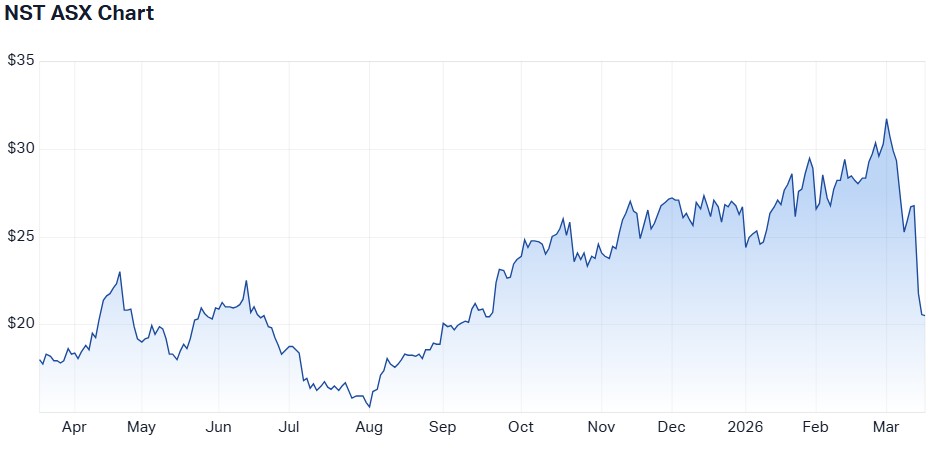
Northern Star price chart (Source: Market Index)
Where to from here
Management has committed to setting the company up to achieve its full potential from the start of FY27, with Tonkin stating the production focus will be on "extracting ounces in the most effective way, from both a cost and mining efficiency perspective."
Jundee is also undergoing an operational review, with surplus personnel and equipment expected to be redeployed to higher-margin operations during the June quarter.
NST has also flagged medium-term production, cost and capital forecasts to be released before year-end, a direct response to investor demand for greater visibility on the asset base.
The company is scheduled to release its March quarterly report on Wednesday, 22 April 2026.