Mortgage holders should expect two more interest rate hikes, not one – UBS
UBS now thinks the RBA will hike two more times, taking the cash rate to 4.85% – though it concedes the tally could just as easily be three.


Source: Shutterstock
KEY POINTS
- The RBA has already raised the cash rate three times this year to 4.35%, and Deputy Governor Andrew Hauser has publicly asked whether that’s been enough. UBS delivered its answer this week: it hasn’t been, and two more hikes are coming.
- A geopolitically driven spike in oil prices is the immediate trigger, but the AI boom is also stoking inflation, and central banks around the world have pivoted hawkish in recent months.
- UBS now expects a hike at the RBA’s September meeting, a second in November, a peak cash rate of 4.85% to hold for about 12 months, and house prices to tumble as much as 10%.
Australian borrowers have already worn three rate rises this year, with cost-of-living pressures acute and bowser prices climbing. Since the last hike in February, the debate has mostly been about whether the RBA had one more in it. Personally, I haven’t read a single forecast that predicted two.
That changed on Thursday. In an Australian Economic Comment note, major global investment bank UBS said recent events had met its triggers for a base case change: it now expects two more 25 basis point hikes, to 4.85%. It describes the risks around that view as balanced, seeing a similar chance of three more hikes as of only one.
But that last tidbit – the one-and-done scenario – will feel tenuous to Aussie mortgage holders right now. The bank’s economics team, led by George Tharenou, gives three reasons for the upgrade to two forecast hikes.
Reason one: the AI investment boom
UBS argues the global AI-related investment boom keeps gathering pace and surprising to the upside, and that it’s now more clearly adding to global demand and inflation pressure – an effect it says has become more evident in Australia recently.
Reason two: the spike in fuel prices is about to hit the CPI
The more immediate pressure is at the bowser. UBS estimates automotive fuel prices in the August monthly CPI surged around 16% month-on-month, contributing a very large ~53 basis points (+0.53%) to headline CPI in that month alone. September fuel is tracking around 7% higher again, worth a further ~23 basis points (+0.23%).
On UBS’s numbers, that lifts headline CPI back to around 4.0% year-on-year in August. It also feeds the trimmed mean the RBA actually targets – directly, by taking up room in the distribution, and indirectly as businesses pass on costs.
That lands on top of July’s CPI jump, which UBS attributes in part to the Fair Work Commission’s 4.75% p.a. wage decision – an impact business surveys imply continued through August.
UBS has accordingly revised up its September quarter forecasts: headline CPI of 3.8% p.a., a tick above its previous 3.7%, and trimmed mean CPI rebounding to 3.6% p.a. Both sit above the RBA’s 2–3% p.a. target band, and on UBS’s numbers the trimmed mean is tracking hotter than the profile implied by the RBA’s own forecasts.
UBS expects the upside surprise in CPI to force the RBA to revise up its own inflation forecasts in the November Statement on Monetary Policy, and to hike again at the same meeting.
Reason three: central banks have turned hawkish
The third leg is global. UBS says the reaction function of major central banks – especially to inflation – has clearly turned more hawkish, and that their rhetoric is increasingly being matched by action. Hawkish simply means a central bank is more likely to increase interest rates, whereas dovish means the opposite.
The US Federal Reserve is the clearest example. It hiked 25 basis points (+0.25%) this week alongside hawkish projections, and UBS has affirmed its expectation of a further Fed hike in December. Chair Kevin Warsh described the move as removing only a “dose of accommodation” – language UBS reads as implying the Fed doesn’t consider policy restrictive at all.
Locally, UBS assessed the RBA’s August meeting and several subsequent speeches as unusually hawkish, signalling an urgency to move back to back. Deputy Governor Andrew Hauser has been explicit, noting “inflation is too high, and that’s why we raised interest rates three times at the beginning of this year”, before framing the live question as whether enough has been done “or is more needed”. He’d come back from a recent US trip, he added, “a bit more worried”.
Where UBS thinks it could be wrong
The bank is upfront about the fluid nature of its call. The RBA may treat an early September hike as a sufficient response to the September quarter print, hold in November, and wait for a second quarterly upside surprise in the December quarter data – pushing the next hike out to February 2027.
Either way, on its base case UBS expects the RBA to hold at 4.85% for around 12 months, forecasting 25 basis point cuts in November 2027 and February 2028. The reason for the cuts will be cold comfort to homeowners though: UBS expects government tax changes and RBA hikes combined to drive house prices down towards 10% – the largest decline on record.
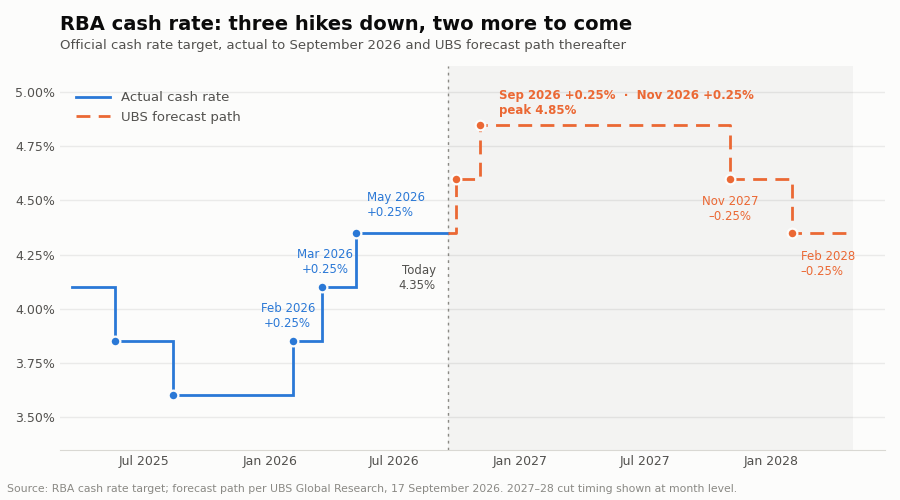
Actual RBA official cash rate path including last three hikes, plus UBS' forecast path including two more hikes, and eventual cuts in 2027 and 2028. Source: RBA and UBS.
What it means for borrowers
For mortgage holders, the takeaway is that the tightening cycle isn’t in its final act. On UBS’s base case, a variable rate borrower should be budgeting for 50 basis points more, not 25, with the first instalment potentially landing this month.
The caveat is the risk sits either side of this forecast, and the final result likely hinges on the September quarterly inflation print due on 28 October – just six days before the November interest rate announcement. A single soft trimmed mean number would change the arithmetic.
What’s harder to argue with is the direction of pressure on official interest rates. Fuel is up, wages have been lifted by decree, and the Fed and other major central banks are hiking. Inflation has been overshooting their targets for years and it appears they’re no longer inclined to give it the benefit of the doubt.
Source: UBS Global Research, Australian Economic Comment, 17 September 2026 (George Tharenou, Stephen Wu, Izzy Lowe, Tatiana Bodrova).