Making sense of the ASX 200 turnaround as Aussie jobs data disappoints
A weak jobs print rescued the ASX 200 from an early slide. But yields are easing for the wrong reason, and defensives aren’t cheap.

Source: Gemini
KEY POINTS
- Unemployment came in at 4.7% as employment fell 39,300, sending the 3-year bond yield down 12bps to 4.80%, with traders paring back rate hike bets.
- Woolworths rose over 4% and CBA 3% as investors fled to defensives. But safety isn’t cheap, with the supermarkets on 25x FY26 earnings and CBA a trailing 24x.
- Micron and Nvidia account for 36% of the S&P 500’s forecast 27.2% Q3 earnings growth. If the AI trade falters, little else can carry the load.
This could be one of the most confusing sessions the market has seen in a long while. The S&P/ASX 200 has clawed back an 86 point drop (-0.99%) to trade roughly breakeven as staples, financials and telcos soar more than 2%, while tech and miners have tumbled more than 3%.
We unpack the sequence of events behind such a bifurcated market below.
US inflation runs hot, AI trade crumbles
The ASX 200’s early slide made sense after Wall Street struggled overnight on a slightly hotter-than-expected inflation report and a deepening selloff in AI-related stocks.
Here's the overnight session in a nutshell:
Major US benchmarks: S&P 500 (-1.1%), Nasdaq (-1.8%), Dow (-0.09%) and Russell 2000 (-1.9%)
September inflation: Headline CPI up 0.6% month-on-month, with the annual rate accelerating to 3.7% from 3.4% a month ago and above market expectations of 3.6%. Core inflation also up 0.3% month-on-month, lifting the annual rate to 2.6%, also above market expectations of 2.5%
CoreWeave: 2032 bonds fell below 80 cents on the dollar into distressed territory, while CEO Mike Intrator told staff the market is acting “irrationally”
Korea's Kospi: Down for a sixth straight session on Wednesday, down about 14% since 2 October
Commodities: Silver slumped 6% to US$55.61/oz and gold fell 1.3% to US$4,105/oz, while copper dropped 1.6% to US$6.67/lb, iron ore slipped 0.4% to US$90.35/t and Brent eased 0.3% to US$106.03/bbl
What’s interesting is that the Dow finished just shy of breakeven, with 17 of its 30 constituents (57%) closing higher. Most of the gains came from healthcare, consumer staples and energy names such as Walmart, Procter & Gamble and Coca-Cola.
That overnight lead pointed to a risk-off session for tech and miners, with some appetite for defensives like staples and telcos. On balance, though, the hotter-than-expected US inflation data made it arguably a net negative.
Aussie unemployment at 4.7%
The market was off to a rough start but surged after September unemployment data came out weaker than expected.
Unemployment rate stood at 4.7% vs. expectations of a decline to 4.6%
Employment fell 39,300 vs. expectations of a 20,000 gain
Part-time employment fell 73,700 to 4.55 million, while full-time employment rose 34,400 to 10.23 million
Participation fell 0.2 ppt to 66.8% vs 67.0% ests, its lowest level in four months
The ASX 200 spiked from a 0.75% decline to a 0.45% decline within the first minute of the report being released at 11:30 am AEDT. By around 12:50 pm, the index was trading at breakeven.
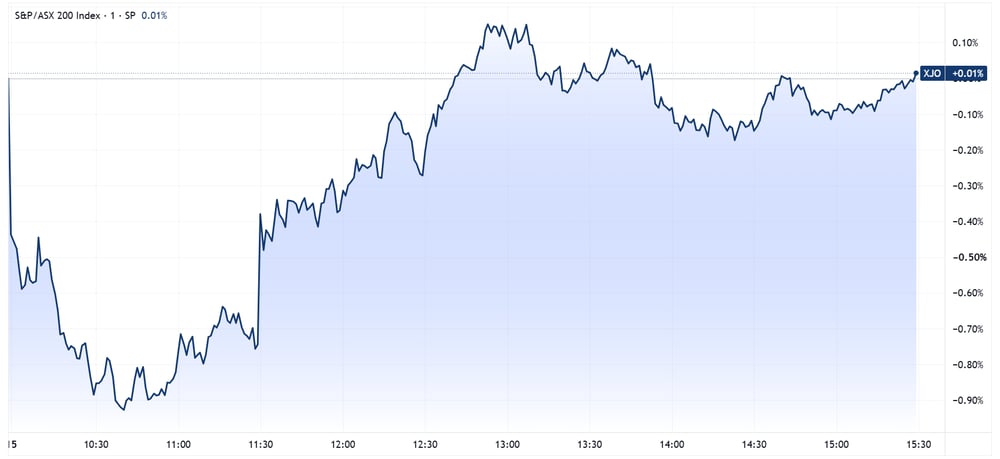
S&P/ASX 200 intraday chart (Source: TradingView)
The soft jobs report prompted traders to pare back wagers on further rate hikes, with the policy-sensitive Australian 3-year government bond yield down 12 bps to 4.80%, the lowest since 9 September.
The prospect of fewer rate hikes bolstered consumer-facing and yield-sensitive sectors like staples, banks, telcos and discretionary.
The Kospi sinks further
While the ASX 200 reversed early losses, Asian chip stocks extended the global AI selloff.
South Korea's Kospi fell as much as 7.9%, on track for a seventh straight decline and its lowest since early April. Key names like SK Hynix and Samsung both fell more than 9%, with SK Hynix now down 57% from its June peak.
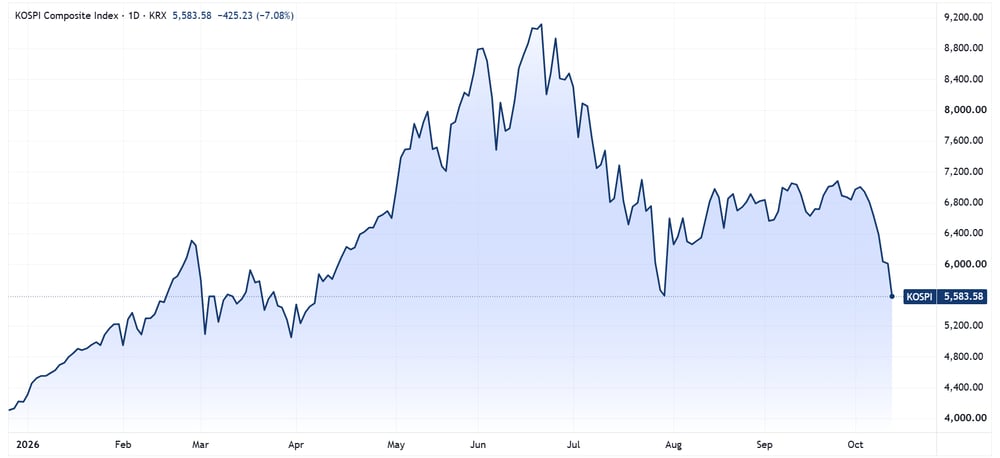
Kospi year-to-date price chart (Source: TradingView)
Elsewhere, the Nikkei 225 is down more than 4% and the Taiex down more than 3%, while China’s Star 50 hit its lowest since April.
Where to from here?
It’s a tricky spot, with bond yields easing because growth is weakening rather than because inflation is cooling.
The market has responded by turning defensive, with Woolworths up more than 4%, Coles soaring over 2% to near record highs and the big banks broadly higher, led by CBA (up 3.0%) and Westpac (up 2.2%). The catch is that investors are paying up for safety in slower-growing parts of the market, with Coles and Woolworths both trading on FY26 adjusted PEs of 25x and CBA on a trailing 24x.
At the other end, miners and tech are getting smashed, with BHP and Rio Tinto both down more than 4%. It seems that commodity prices and miners are increasingly sensitive to the AI trade. That’s a problem, because AI is where the earnings growth is coming from. S&P 500 earnings are forecast to grow 27.2% year-on-year in the third quarter, with Micron and Nvidia alone accounting for 36% of that figure, the next eight biggest contributors adding another 30% and the remaining 490 companies making up the last 34%.
So really, the AI trade needs to find its footing, because if it doesn’t, there isn’t much else left to carry earnings growth and today’s pivot into defensives may well prove to be the right call.