James Hardie upgrades FY27 cash flow guidance but not earnings, shares dip 5%
James Hardie lifted its FY27 free cash flow by ~20% but the stock still tanked on the lack of sales and earnings upside.

Source: iStock
Mentioned
James Hardie (JHX) lifted its FY27 free cash flow target by 20% to roughly US$600 million at its first investor day since the AZEK merger, and said it will hit its US$125 million cost synergy target a year ahead of schedule. The company also reaffirmed its second-quarter and full-year sales and adjusted EBITDA guidance.
Despite the higher cash flow guidance, NYSE-listed James Hardie shares fell 4.4% overnight, while the stock is down 5.2% in early trade to $37.29 on Wednesday.
Why it matters: Management said the guidance does not assume a housing recovery. The new 4-7% organic growth target sits above market through the cycle, funded by a US$23 billion material conversion opportunity and US$500 million of revenue synergies over five years.
By the numbers:
FY27 free cash flow guidance lifted by 20% to "about" US$600m from US$500m
FY26 free cash flow US$425m, after roughly US$207m of deal and integration costs
Free cash flow conversion guided to 38% in FY27 vs. 30% in FY26, guided above 40% thereafter
Cost synergies US$125m exit run rate by end FY27, a year ahead of the original plan
Capex 6%-7% of sales in FY27 vs. 7.8% in FY26
Net leverage 2.4x by end FY27 and below 2.0x by the second quarter of FY28
What they're saying:
The US$500 million revenue synergy target is a floor, not a forecast: "at least $500 million of commercial synergies for us," CEO Aaron Erter said.
The 4-7% growth algorithm is "not market-dependent", and Erter declined to break it into components, calling it a portfolio where one lever offsets another year to year.
No relief on input costs. CFO Ryan Lada said the company has "seen no relief on fundamental costs, including freight and diesel."
Faster fiber cement lines will not need meaningful capital. The spend is "a level of CapEx you guys won't notice," COO Ryan Kilcullen said, with line speeds up 5% over 12 months.
Australia and New Zealand is "our most profitable business," Erter said, with AZEK decking technology due to launch there next year.
The backdrop: Shares are down around 12% since late August 2025. The stock fell 34% over two days after the August 20 first-quarter result, which showed sales down 9%, adjusted EBITDA down 21% and adjusted EPS down 28% on channel destocking and weak North American repair and remodel demand. A soft Q2 result and MSCI Australia Index removal in November also tanked the share price further. From here, James Hardie managed to claw back most of its declines. On 19 May, it managed to exceed the heavily reduced guidance, followed by earnings upgrades in July and August.
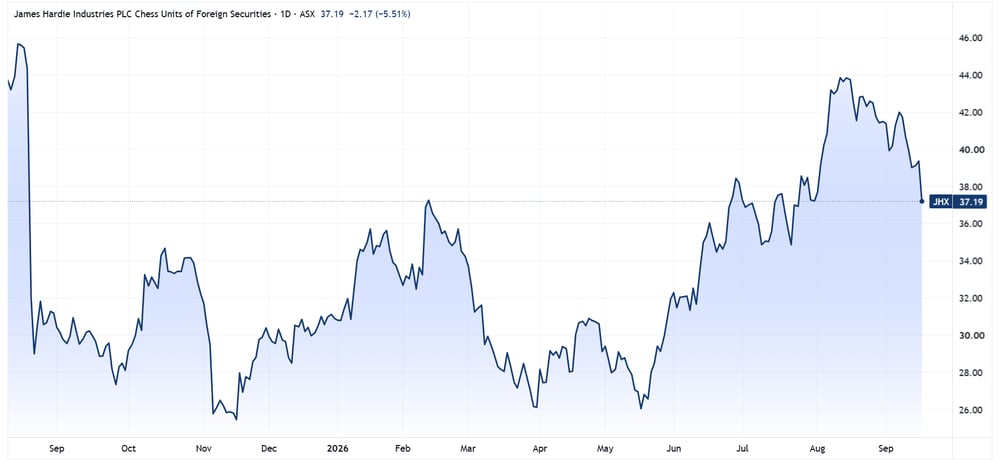
Reality check: The raise was to free cash flow alone. Sales and adjusted EBITDA guidance were left unchanged, and part of the step-up is the absence of the US$207 million of deal and integration costs that depressed FY26. So an upgrade, but not really.
What's next: The €840 million (~US$980 million) sale of European walling business Fermacell to Holcim closes in the first half of FY27, funding US$600 million of debt paydown and a US$250 million buyback. Europe moves to discontinued operations from the second quarter.