Is it time to get bullish on BHP, Rio Tinto and Fortescue?
Everyone's bearish on iron ore. UBS and Macquarie aren't, and history says November to January is its best stretch of the year.

Source: Shutterstock
Mentioned
KEY POINTS
- UBS lifted its long-term iron ore forecast to US$93 a tonne from US$85, about 12% above consensus. A fall to US$85 would push roughly 255Mt of supply into losses
- Macquarie calls Fortescue a counter-consensus trade on cost support and would use any weakness from a CMRG-related outcome at its upcoming quarterly as a buying opportunity
- Iron ore prices have risen in 12 of the past 16 Decembers, averaging 6.39%, and 11 of 16 Novembers, averaging 4.27%, buoyed by Chinese mill restocking and supply disruptions
The only thing that's bullish about iron ore is that everyone is bearish. To be fair, that's against an understandable backdrop of a sputtering Chinese property sector dragging on steel demand, a wave of new supply as Simandou ramps up and Beijing's push to cap crude steel output.
This seemingly universal pessimism has been right so far, with iron ore prices down ~6% year-to-date to US$90.80 a tonne, the lowest since July 2025. That's dragged a key name like Fortescue down 26% year-to-date, also to its lowest since July 2025.
But two interesting pieces of research have made a fairly counter-consensus bullish case for the steelmaking ingredient, just as iron ore heads into its historically strongest three-month stretch.
The case for higher iron ore
UBS lifted its long-term iron ore forecast last week to US$93 a tonne from US$85, about 12% above the US$83 consensus.
At US$95 a tonne, spot prices sit between the 90th and 95th percentiles of the cost curve. That means ~5% of seaborne and Chinese domestic supply, or ~85 million tonnes a year, is cash negative, which UBS says "continues to provide a degree of cost curve support, even as market fundamentals appear softer".
Here are some of the key takeaways from the research note:
China's steel demand has fallen ~21% from its 2020 peak to 796 million tonnes, but production is down only ~3% as mills redirect output towards manufacturing and exports. China now exports 130 million to 150 million tonnes of steel a year inside cars, machinery and ships, and blast furnaces run near 90% capacity.
Steel production across 14 developing economies, including India, Indonesia and Vietnam, is forecast to rise from 434 million tonnes last year to 640 million by 2035. UBS tips India's seaborne iron ore imports to climb from 10 million tonnes to 117 million. With little scrap available to recycle, that steel growth will lean on blast furnaces fed by iron ore.
Supply is weaker than the tonnes suggest. Falling grades mean the market needs about 50 million tonnes more ore this year than earlier forecasts assumed. Rio Tinto estimates 650 million of the 800 million tonnes that need replacing by 2035 are still uncommitted. UBS expects spending on new supply from 2027 to 2035 to run ~60% below the previous nine years.
The cost curve sets a higher floor than the market assumes. UBS says surplus markets tend to trade around the 90th percentile of costs, which analysts put at ~US$92 a tonne. A fall to US$85 would push ~255 million tonnes of supply into losses or out of the market, rising to 357 million tonnes at US$80. For context, Simandou's nameplate capacity is 120 million tonnes a year.
Macquarie backs Fortescue
Macquarie also offered some iron ore insights last Thursday, calling out Fortescue as a "counter-consensus trade" and citing cost support as a key driver of a near-term recovery.
Benchmark iron ore prices are down more than 10% this year, and higher freight has pushed FOB netbacks, the price miners receive after shipping costs, down further.
That squeeze is making cost support more visible and prompting some marginal supply cuts. Macquarie says Simandou's growth and softer Chinese steel demand still limit the case for a tighter market.
The downside hasn't gone away. An outcome related to China Mineral Resources Group (CMRG), Beijing's state-backed iron ore buyer, could weigh on Fortescue around its upcoming quarterly update. But Macquarie says it would "use any resulting weakness as a buying opportunity".
Iron ore's best stretch of the year
Iron ore has historically had its strongest run of the year from November to January, after a soft patch through September and October. November has risen in 11 of the past 16 years for an average gain of 4.27%, and December in 12 of 16 for 6.39%. January has added another 2.38% on average, though it's only risen in half of those years.
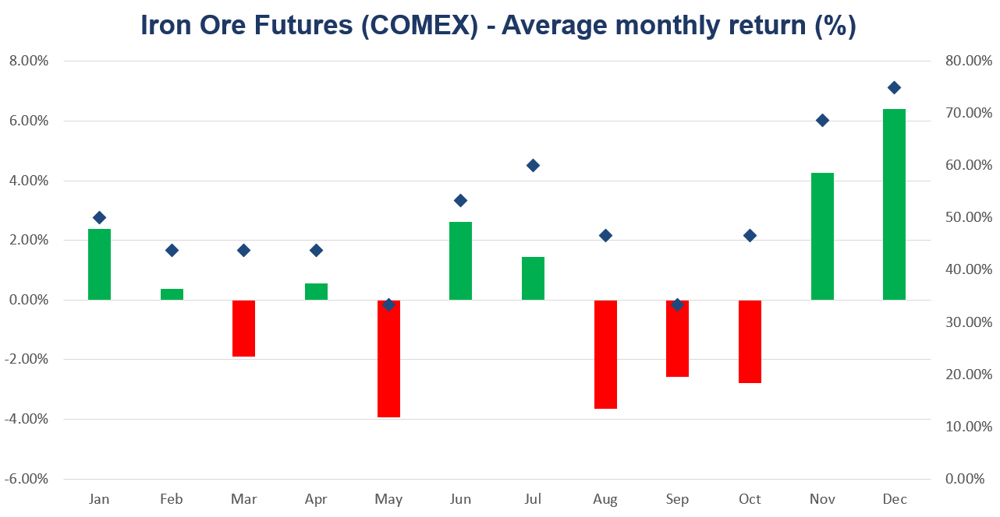
Iron ore futures (COMEX) seasonality (Nov-2010 to Apr-2026)
Here are a few key takeaways from the seasonal data.
The run follows a weak stretch. Iron ore has risen in only five of the past 15 Septembers and seven of 15 Octobers, with average falls of 2.58% and 2.79% respectively. October's median of -3.42% is the worst of any month.
Chinese mills restock through to January. They tend to rebuild iron ore inventories late in the year ahead of the Lunar New Year shutdown, lifting import demand.
Supply tightens over summer. Brazil's wet season, which starts around November, and the Pilbara cyclone season tend to disrupt first-quarter shipments from the world's two largest exporters. Buyers typically start pricing that in ahead of time.
Beijing's big policy meeting lands in December. The Central Economic Work Conference sets the economic agenda for the year ahead, and expectations of property and infrastructure support often build into year-end.
Overall, analysts are bearish on iron ore for obvious reasons, and it's been an especially challenging year as prices slip towards US$90 a tonne. The data above doesn't necessarily make a bullish outcome the path of least resistance, but cost curve support and seasonal tailwinds do plant the seed for a comeback, as iron ore heads into its best three-month stretch of the year.