Iron ore enters its best three months, but Fortescue has a China problem
Iron ore heads into its most bullish three months, but weak China data and the CMRG standoff are weighing on Fortescue.

Source: iStock
Mentioned
KEY POINTS
- Iron ore has risen from November to January in 11 of the last 16 years for an average gain of 14.4%, and Fortescue has rallied in 12 of those windows.
- China’s manufacturing PMI fell to 49.3 in October and port stockpiles are 15% higher than a year ago, so the macro backdrop works against a strong year-end finish.
- Fortescue shares are down 35% amid the CMRG standoff, and the miner has warned production could be hit if talks run past year-end.
Iron ore prices have struggled this year as China’s property slump drags on and construction activity contracts, while plentiful seaborne supply has pushed port stockpiles some 15% higher year-on-year.
Iron ore is down 6% year-to-date to US$91 a tonne but Fortescue shares have fared far worse, down 35% to the lowest since April 2025 amid a drawn-out standoff with state-backed buyer China Mineral Resources Group (CMRG). The dispute has left millions of tonnes unsold and prompted a warning that production could be hit if talks drag past year-end.
Here are the latest on China's economic data and Fortescue's September quarter report.
China’s official manufacturing PMI fell to 49.3 in October from 50.1 in September, missing ests of 50.0 and marking its lowest reading since July
The construction activity index slid 2.3 points to 48.0, while construction new orders plunged 5.7 points to 40.0
Port stockpiles rose for a fifth straight week to 173.7Mt at the 47 ports Mysteel tracks as of 15 October, 15% above a year earlier, according to Mysteel
Iron ore imports fell 5.6% year-on-year to 109.8Mt in September, with year-to-date imports up 4.1% to 955Mt, slowing from 5.5% growth over the first eight months
New home prices fell 2.8% year-on-year across 70 cities in September, easing from a 3.0% drop in August but marking a 39th straight month of declines
Fortescue’s shipments fell 6% to 46.8Mt vs 47.5Mt ests (1% miss), while net debt more than tripled to US$2.8bn from US$0.9bn at 30 June after the US$1.0bn final dividend and US$916m of capex
Fortescue warned operations, potentially including production, may be affected if CMRG talks aren’t concluded by year-end, after September quarter sales of 42.9Mt trailed shipments by 3.9Mt
Funnily enough, Macquarie called out Fortescue as a “counter consensus trade” exactly a month ago, on the view that falling prices could drive some marginal supply cuts. Though Simandou’s ramp up and softer Chinese steel demand may limit the case for a strong near-term recovery. The shares have tanked around 13% since.
Iron ore's best three months
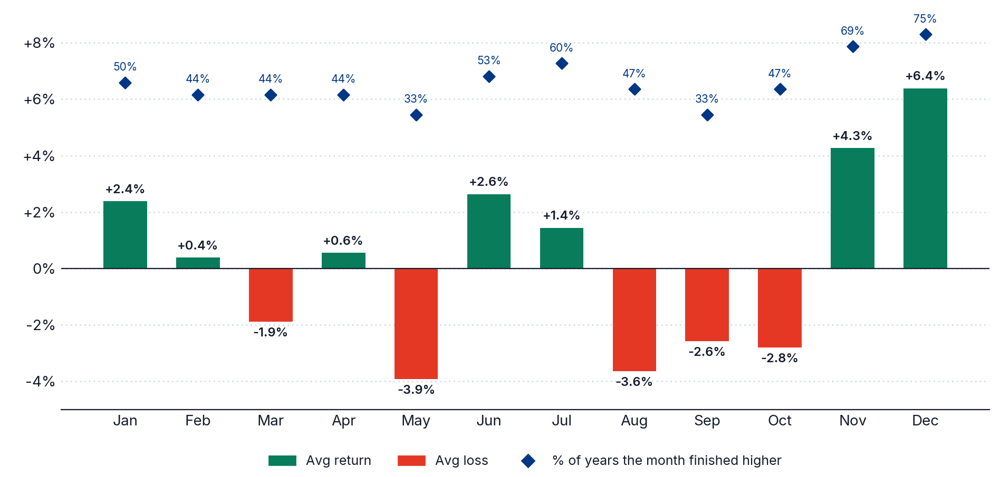
November kicks off the most bullish three-month stretch for iron ore prices. Since 2010, iron ore has averaged a 14.4% gain from November to January and finished higher in 11 of 16 years. November is solid (average gain of 4.3%, higher 69% of the time), but December is the standout at 6.4%, higher 75% of the time.
There’s no single reason iron ore tends to rally over this period. The most common explanation is a mix of Chinese steel mills building stockpiles before winter and Lunar New Year, Brazil’s rainy season (November to April) and Chinese policy and credit expectations peaking, with December’s Central Economic Work Conference and elevated new bank lending in January.
Iron ore futures (COMEX) average monthly return
Source: Market Index
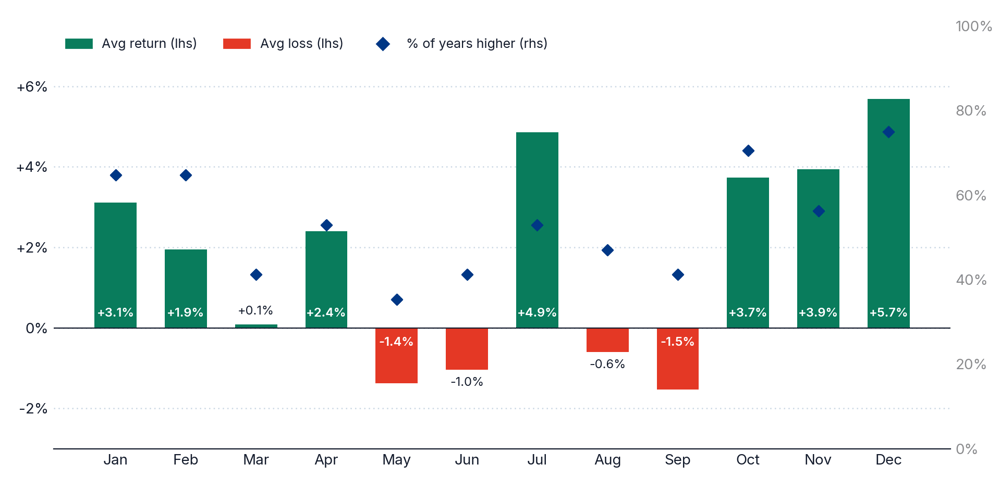
Fortescue has also traded higher over the November-January stretch in 12 of 16 years since 2010, with an average gain of 10.8%. In the 11 years iron ore rose over that window, Fortescue rose in all but one.
Fortescue average monthly total return
Source: Market Index
Before 2018, though, Fortescue badly trailed the commodity. Its median November-January return was just 3.2% against iron ore’s 18.7%, and it lagged in seven of those eight years.
Over the full period, Fortescue has typically moved around 0.73% for every 1% move in iron ore, so iron ore only explains about half of the price action. That leaves plenty of room for macro and company-specific factors, such as an aggressive green hydrogen campaign between 2021 and 2023, an executive exodus in 2023 (CEO Fiona Hick and CFO Christine Morris both resigned within days of each other) and now the CMRG standoff.
The bottom line
Iron ore is entering its historically most bullish patch of the year, yet the macro environment is arguably against a strong finish. For Fortescue, the outcome of the CMRG talks are a key catalyst, which falls right in the middle of the seasonal window.
While historicals have pointed to strong gains over the next three months, the rally has faded as of late, with the last two November-January windows (2024 and 2025) roughly flat for iron ore and slightly lower for Fortescue.