UBS names the ASX stocks to hold if a property downturn hits
UBS has downgraded the banks and reshaped its preferred list, naming the sectors and stocks best placed to weather a housing slowdown.


Source: Shutterstock
KEY POINTS
- UBS has downgraded Australian banks to Underweight and named banks, consumer discretionary and real estate as the most exposed sectors after last week's Federal Budget scaled back favourable tax treatment for residential property
- The broker prefers mining, industrials and healthcare, with CBA, Westpac, Stockland and Mirvac flagged as most at risk, while BHP, Santos, ALS, Hub24 and more have been added to the preferred list
- The Australian economy faces a three-pronged squeeze from elevated oil prices, an ongoing RBA hiking cycle pencilled to lift the cash rate to 4.60% in August, and Budget tax changes that UBS calls a structural threat to the housing wealth effect
UBS is urging clients to rotate out of Australian banks and real estate and into mining, industrials and healthcare, warning last week's Federal Budget could trigger a housing wealth effect unwind that investors have long flagged as a tail risk.
Strategists Richard Schellbach and Lily Huang name banks, consumer discretionary and real estate as the most exposed sectors, while mining, industrials and healthcare are the team's preferred hiding spots.
"Last week's Federal Budget was the most consequential to investment markets in decades," UBS wrote, pointing to government changes that scale back favourable tax treatment for residential property.
The analysts believe the longer-run read is actually equity-friendly, since shares look more attractive relative to housing under the new rules. But in the near term, the property market now faces pressure from three directions, all at once.
The three-pronged squeeze
UBS says the Australian economy is now facing a "three pronged" challenge from:
A stagflation shock from elevated oil prices tied to the Middle East conflict, which is lifting inflation and squeezing margins
An ongoing RBA hiking cycle, with three hikes already delivered since February and another 25 bp move pencilled in for August to take the cash rate to 4.60%
Housing cycle headwinds from the Budget's tax changes, which UBS calls a structural threat to the wealth effect Australia has relied on for decades
The first two were already weighing on rate-sensitive parts of the market, with sectors like Real Estate and Discretionary down 10% and 13% year-to-date, respectively, while the tax changes add more uncertainty to the mix.
What history says about soft housing periods
Australia has never really had a housing bear market. The closest analogues are the prolonged stagnation from 1992 to 1996 and the short, sharp correction of 2018-19. In both episodes, banks underperformed the broader market by a wide margin. Builders and real estate stocks also lagged through the early 1990s.
During the 2018-19 episode, banks and builders fell behind, but REITs actually outperformed, buoyed by M&A activity and the RBA's rate-cutting cycle that kicked off mid-2019. Hence, a housing slowdown does not punish every property-adjacent sector equally.
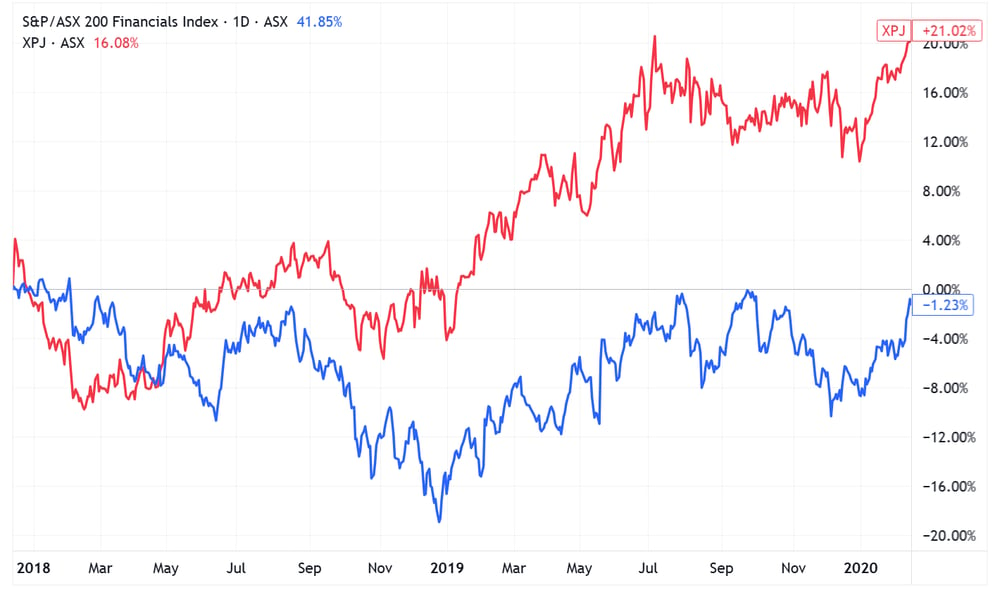
S&P/ASX 200 Financials Index vs. S&P/ASX 200 A-REIT Index (Source: TradingView)
UBS also points to Canada and New Zealand as offshore comparisons, though the read-across is a little muddied. The Big Four Australian banks dominate New Zealand mortgages, and Canadian banks have asset management and markets businesses that cushion them in ways their Australian peers don't.
The stocks in the firing line
UBS banks analyst John Storey flags CBA and Westpac as the most exposed of the majors, given their portfolios are tilted toward mortgage growth. The Budget's reduced incentives for property investing also work against bank margins, since investor loans typically price better than prime owner-occupier loans.
In real estate, Stockland and Mirvac carry the heaviest direct exposure. Both sell roughly 30-35% of residential product to investors. Stockland's share of net sales has averaged 28% and Mirvac's share of settlements sit around 33%.
The knock-on effects spread well beyond banks and developers:
Hardware sales weakness would hit Metcash and Wesfarmers
Slower home renovation and turnover would weigh on Adairs, Temple & Webster and Harvey Norman
Softer housing-related employment would challenge Eagers Automotive and ARB Corporation
Where UBS wants to be invested
Mining stays Overweight, a view UBS has held since last year. The sector is the only part of the market still seeing positive earnings momentum, against EPS downgrades across every non-resources sector.
Industrials get the nod because end-demand is largely structural, drawn from mining services, government infrastructure, defence, the energy transition and data centres. It remains relatively immune to a housing slowdown.
Healthcare is the contrarian call. UBS acknowledges sentiment is abysmal and momentum looks non-existent. However, the sector trades at an unprecedented discount to the ASX 200. The analysts believe patient investors will get paid, and the sector's lack of correlation to oil and housing risk gives it defensive properties most of the market lacks.
Changes to the preferred list
UBS has added the below companies to its most preferred stocks list:
BHP and Santos play the supply-constrained commodities thesis
ALS rides the mining exploration cycle
Hub24 benefits as the Budget makes non-housing investments more appealing
Aristocrat brings US economic exposure and a record of holding up through downturns
CAR Group captures both trading-up and trading-down car markets
Telix joins ResMed as a healthcare pick trading at historically cheap levels
To make way for these additions, UBS removed Rio Tinto, Mirvac, NIB, Westpac, Cochlear, Metcash and REA Group. Meanwhile, the least preferred list now features Aurizon, CBA, Harvey Norman, Inghams, Mirvac, Reece and Westpac.