How to position your ASX portfolio through geopolitical shocks and a more hawkish RBA
UBS reshuffles ASX sector calls amid Middle East conflict, a hawkish RBA shift, and ongoing AI market fallout.

.jpg)
Source: Shutterstock
KEY POINTS
- UBS has upgraded Industrials to overweight and downgraded Real Estate to underweight, citing earnings momentum and rising rate risk respectively.
- History shows geopolitical shocks have had limited lasting impact on Australian equities, though UBS warns elevated starting valuations reduce the market's tolerance for an earnings downturn.
- Miners remain UBS's core overweight conviction, with the firm expecting recent Energy earnings downgrades to reverse as the conflict tightens oil and gas markets.
Australian investors are navigating three concurrent disruptions: An escalating conflict in the Middle East, a more hawkish interest rate outlook from the RBA, and continued fallout from the AI-driven technology sell-off.
UBS equity strategists have responded by reshuffling their sector recommendations, moving Industrials to overweight, downgrading Real Estate and reiterating a bullish stance on Materials.
Geopolitics rarely derails Australian equities
UBS examined 15 geopolitical shocks over the past 50 years and found the S&P/ASX 200 returning an average of 4%, 5% and 11% over the subsequent 3, 6 and 12 months. The main exception was the first Gulf War, which inflicted lasting damage. UBS warns that a conflict escalating to that scale would likely drive further market weakness, but if the current situation remains contained, the worst may already be priced in.
The key caveat this time is starting valuations. UBS notes that stocks in both Australia and the US are entering this shock at elevated price-to-earnings multiples, which leaves less room for error. A turn in the earnings cycle from here would likely produce a sharp correction.
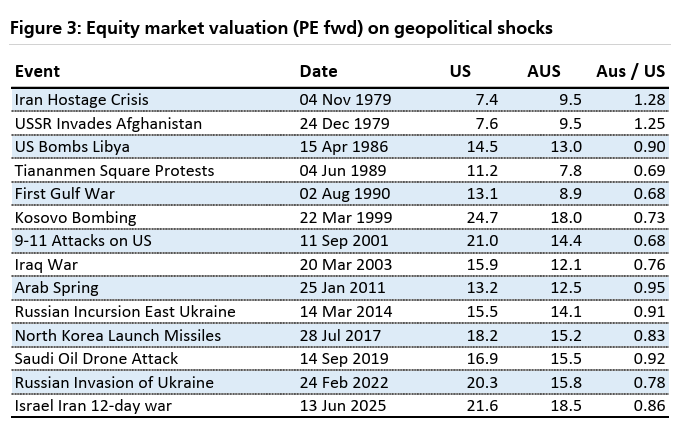
Source: UBS
Energy impact: Inflation vs. growth
Australia imports oil but is a net energy exporter through its large LNG earnings. UBS notes that higher energy prices therefore create a split outcome: A headwind to consumers via petrol prices, but a potential boost to the broader economy.
The analysts frame the central question for investors as whether this shock becomes an inflation story or a growth story. The answer determines positioning: inflation fears favour commodities and real assets, while growth fears would push investors toward defensive and quality businesses.
Sector changes: Industrials upgraded, Real Estate downgraded
UBS has made the following sector recommendation changes:
Industrials upgraded to Overweight. The sector ranks highest on UBS's quantitative sector tracker, scoring well on earnings momentum, macro factors (rates and AUD), and earnings quality. Results through the February reporting season showed stable end demand in Australian operations. UBS also positions Industrials as a relative safe haven for investors wanting to reduce exposure to global uncertainty.
Banks upgraded to Neutral (from Underweight). February results were solid and UBS expects further earnings upgrades ahead. UBS economist George Tharenou added an additional rate hike to his forecasts this week, on top of a 25 bp move already expected at the May meeting, which provides further tailwinds for the sector.
Energy upgraded to Neutral (from Underweight). This reflects a direct response to the likely oil and gas price impact of a prolonged conflict. UBS notes that Energy screens poorly on its quant model due to recent EPS downgrades through February results, but argues these downgrades are likely to flip to upgrades given tightening energy markets.
Real Estate downgraded to Underweight. The sector is exposed to the now more hawkish RBA path and faces potential further earnings downgrades.
Consumer Staples downgraded. UBS prefers Discretionary retailers at this point in the cycle, and views Healthcare as a more attractive defensive option.
Insurance and Technology downgraded to Neutral. Insurers have historically underperformed during geopolitical shocks despite offering attractive relative value versus Banks. For Technology, the analysts acknowledge the sell-off has brought some value back to the sector but are reluctant to call a bottom, arguing the higher risk premium investors now require to hold these names is likely permanent.
UBS has held an overweight on mining since late 2024 and calls it its clearest fundamental conviction. The analysts cite strong earnings momentum, structural diversification away from US equities, and investment flows rotating out of AI-exposed names as the key drivers.