How does the ASX 200 perform in November?
History favours the bulls in November. But the AI selloff, rate jitters and a defensive rotation mean the ASX starts on shaky ground.


Source: Shutterstock
KEY POINTS
- Since 1980, the ASX 200 has averaged a 0.31% gain in November and risen 54% of the time. On a total return basis since 2001, it’s 1.0% and 56%.
- The Nasdaq is 7.8% off its 6 October record as soaring AI capex and negative free cash flow hit megacaps, with Alphabet, Amazon and Intel all tumbling on results.
- Utilities (+10.5%), Financials and Healthcare (+8.3%) led a defensive rotation over the past month. Materials fell 7.3% and small caps slid up to 18.5% since mid-August.
November is historically one of the stronger months of the calendar year, and kicks off the favourable November-to-April stretch for Australian equities (a bullish flip side of "Sell in May and go away").
Since 1980, the ASX 200 has averaged a 0.31% rise in November and finished higher 54% of the time. The data lacks a bit of a “wow” factor, but the stats get a little better on a total return basis.

Source: Market Index
Our S&P/ASX 200 Total Returns data goes back to 2001, with November averaging a 1.0% gain and higher 56% of the time.

Source: Market Index
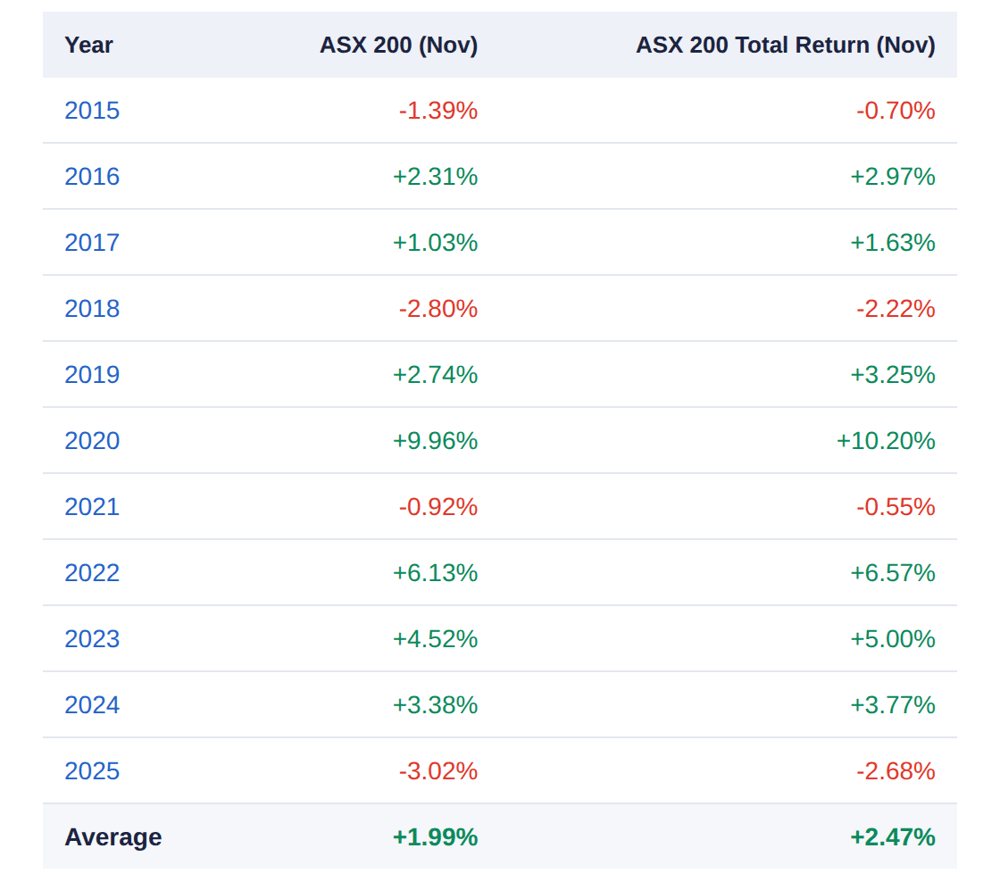
Recent Novembers have done better again, with a higher hit rate and bigger average gains.
Source: Market Index
Where to from here?
Markets enter November at a rather awkward juncture. The Nasdaq is now 7.8% off its 6 October record high amid a broad unwind of all-things-AI. Investors have turned their scrutiny to the high costs of AI infrastructure and escalating debt-funded spending. Recent quarterly earnings from megacap tech stocks have flagged both soaring capex and poor cash flows, including:
Alphabet posted its first top and bottom line miss in nearly four years, Q3 revenue up 25% to $127.58bn, free cash flow negative $9.07bn on AI spending, shares slumped 12.2% last Thursday
Amazon Q3 revenue up 12% to $201.9bn, missing ests, capex of $77.3bn well above $58.7bn ests, trailing free cash outflow of $42.4bn, shares down more than 6% after hours last Friday
Intel shares tanked 28.6% on Friday, worst day since 1974, after Q4 revenue guidance of $15-16bn fell short of ests on a weaker PC market and higher memory chip cost
S&P Global cut Meta’s outlook to negative on hefty capex and negative free cash flow, days after Meta launched a record equity raise of up to $95bn to fund its AI buildout
OpenAI cut its funding round target by $10bn to about $20bn at a $1.25tn valuation, down from $1.4tn, as the AI selloff and Anthropic’s pending listing weigh on commitments, FT reports
As the AI trade falters, the effects are cascading through the broader market. Here on the ASX, we’ve seen:
A rotation into defensive pockets of the market. Over the past month, S&P/ASX 200 sectors like Utilities (+10.5%), Financials (+8.3%) and Healthcare (+8.3%) have all traded notably higher
Materials have sold off 7.3% and at one point, down as much as 19.6% from the recent 26 August record high
Small caps have truly struggled. The S&P/Small Ords and Emerging Companies indices down as much as 15% and 18.5% respectively since mid-August
But even as the S&P 500 and Nasdaq slip, the equal-weight S&P 500 (where every constituent gets the same weighting, regardless of market cap) has risen for four straight weeks and sits within 2% of its all-time high.
So markets kick off November on a tepid note, with AI spending, sticky inflation and tightening liquidity all front of mind. The back end of US earnings season will show whether results are good enough to ease those worries. Rates are the other big question. The renewed hiking cycle looks closer to its end than its start, but investors are already trying to time the last hike, eyeing beneficiaries like retailers and REITs. But with oil still above US$100 a barrel and inflation refusing to cool, that final hike may need a little more time. There's also the US midterm elections on Tuesday, the unresolved US-Iran conflict and Anthropic’s pending IPO. There’s no shortage of catalysts in the month ahead, and they arrive just as the market has historically started to turn higher.