How does the ASX 200 perform in July?
July is quietly one of the market's best months, but the ASX 200 enters this one at a crossroad where the next move could go either way.

.jpg)
Source: Shutterstock
KEY POINTS
- Since 1980, the ASX 200 has averaged a 2.13% July gain and finished higher 72% of the time, ranking it the second-best month of the year.
- Recent Julys have been especially strong, up 2.88% on average and closing higher 11 of the last 12 times,
- The market sits at a crossroad, with easing rate expectations and bottoming consumer sectors offset by falling commodities and softening earnings forecasts.
July is a very underrated month of the year for global equities, ranking as the second-best month for both the S&P 500 and ASX 200.
Since 1980, the S&P/ASX 200 has averaged a 2.13% gain in July and finished higher 72% of the time.
.xlsx%20-%20Excel.png)
Source: Market Index
Our S&P/ASX 200 Total Returns data goes back to 2001, averaging a 1.69% gain in July and higher 72% of the time. This ranks it as the second-best month and equal-first for positive returns, on par with August.
.xlsx%20-%20Excel.png)
Source: Market Index
The most recent Julys have performed very strongly and finished higher 11 of the last 12 times.
.xlsx%20-%20Excel.png)
On Wall Street, JPMorgan observed an average 3.37% return in July for the S&P 500 over the past ten years, with a 100% hit rate. Meanwhile, July has been the best month for the Nasdaq 100 over the same period, averaging a 4.35% return with a 90% hit rate.
Where to from here?
The ASX 200 rose 0.54% last month, though it moved almost 3% in either direction amid a sharp selloff for commodities that offset strength from sectors like Staples, Healthcare and Discretionary, all of which gained 12–13% in June.
The market is sitting at a delicate crossroads, where RBA rate-hike expectations have started to ease and consumer-facing pockets of the market have started to bottom, offset by deteriorating earnings expectations for corporate Australia and a recent decline in commodity prices.
The rate-sensitive two-year yield has fallen around 33 basis points since mid-May, to four-month lows of 4.45%, off the back of falling oil prices and signs of slowing inflation. The lower yield and oil-price backdrop has buoyed battered consumer-facing sectors, with Staples bouncing off a near-six-year low and Discretionary off a two-year low.
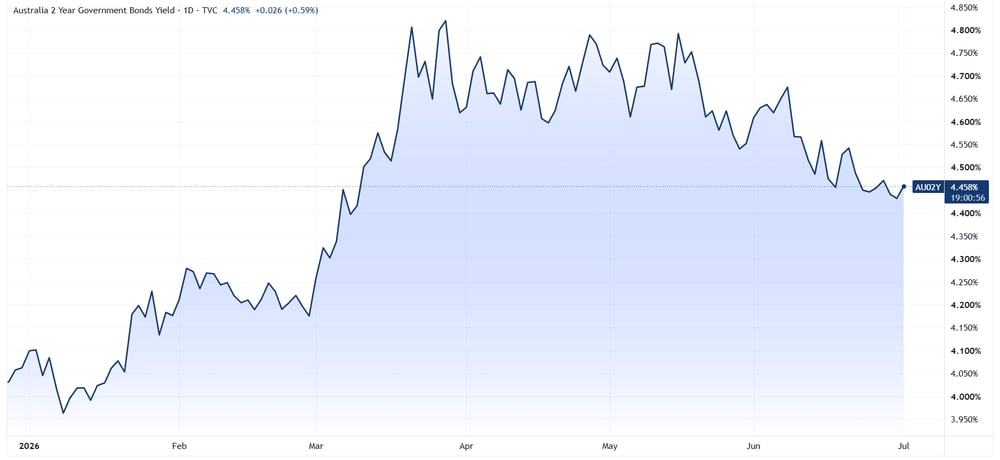
Australia 2-year government bond yield (Source: TradingView)
Meanwhile, analysts at UBS observed last month that outside resources, every sector on the ASX is now seeing forward profit expectations cut, with a growing likelihood of more to come. Despite forward-looking momentum coming to a halt, the investment bank still expects ASX 200 earnings to grow about 12% in FY26.
The ASX 200 could've finished last month a lot higher had it not been for a sharp unwind across the resource sector, with Materials (XMJ) down 6.7% and Energy (XEJ) down 8.8%. Gold is now down 26% from its 29 January record high of US$5,598/oz, copper down 8.3% from its early June record of US$6.7/lb, iron ore traded as high as US$112 a tonne in May but recently undercut the US$100 level, and Brent is now down 35% from peaks of US$113 a barrel.
While history points to a strong July, the market enters it on fickle footing, with plenty of narratives that could drive it in either direction.