Chinese stocks just broke out — here’s how Aussie investors can play the move
Chinese stocks are rising. For Aussie investors, shifting risks and new ETFs offer a chance to play a potentially once-in-a-generation move.

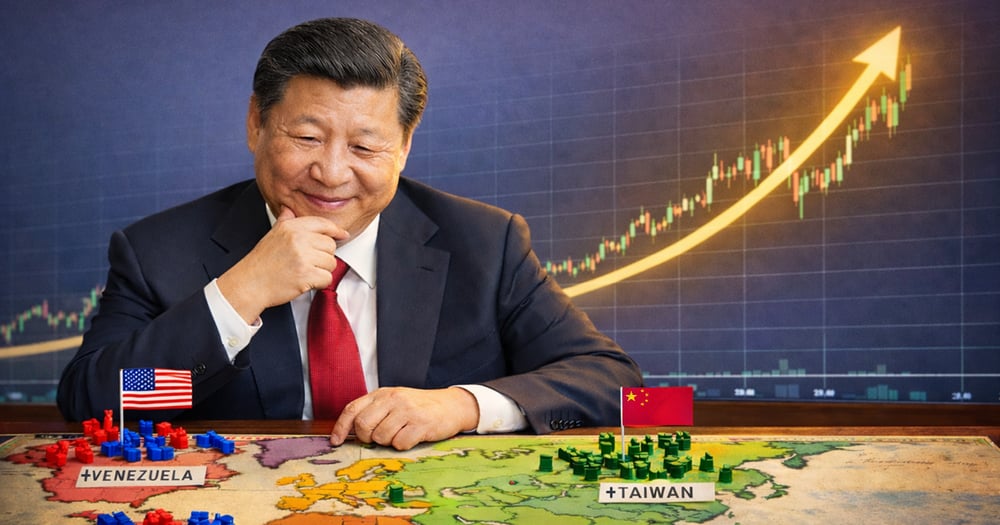
Source: Market Index using ChatGPT
KEY POINTS
- Chinese stocks are rallying in the wake of US military action against Venezuela — a sign markets may be subtly re-pricing geopolitical risk.
- But geopolitics is only part of the story. Easing trade tail risks, improving earnings and rising domestic appetite for equities are all helping fuel a budding bull market — and Chinese bull markets are the stuff of legend!
- This article breaks down the forces driving the rally and highlights the ASX-listed ETFs Aussie investors can use to play a potentially once-in-a-generation opportunity.
For students of financial markets, nothing excites more than the prospect of a major bull market in Chinese stocks. Not because they happen often — but because when they do, they can be explosive. History shows that Chinese equity bull markets tend to arrive suddenly, accelerate rapidly, and reward early movers. Once confidence flips, gains can compound at a pace few developed markets can match, turning what begins as a tactical allocation into a genuine wealth-creation opportunity.
For Australian investors, the allure is even stronger. China remains Australia’s most important economic partner, yet Chinese equities have been deeply under-owned for years. That combination — strategic relevance, depressed positioning, and the potential for a powerful re-rating — is exactly what makes the prospect of a Chinese bull market so tantalising.
%20last%202%20years.png)
Shanghai Composite Index (SSEC) last 2 years
After years of false starts, Chinese equities have finally pushed higher in a way that feels different. The breakout has been broad, sustained, and — crucially — accompanied by a shift in the narrative investors are using to justify owning Chinese stocks again. If this move has legs, it won’t be a slow grind higher — it could accelerate rapidly, leaving latecomers wondering how they missed it.
Let’s explore the forces driving Chinese equities to new multi-year highs, and why the timing — coinciding with recent US actions in Venezuela — may not be pure coincidence.
1. The trade war hasn’t ended — but the tail risk has eased
Markets don’t need trade wars to disappear to keep rallying. They just need the probability of sudden escalation to wane — and that’s what appears to have happened through the back-half of 2025.
The dominant framework in markets that developed in that time is what traders half-jokingly call the “T.A.C.O trade”, i.e., “Trump Always Chickens Out”. It’s the idea that aggressive tariff rhetoric is increasingly followed by delays, exemptions, or negotiated standstills rather than immediate economic shock. That dynamic doesn’t make the US–China rivalry go away, but it substantially lowers the chance of an abrupt tariff shock hitting growth expectations.
In a recent research note, investment bank Citi framed this environment as one in which China’s economy, while slowing, has proven more resilient than many expected, helped by exports in higher-value segments such as technology and critical minerals. In that context, China faces less urgency to respond aggressively to US trade pressure, reducing near-term downside risks for growth and earnings [1].
For Chinese equities, that matters enormously. For much of the past three years, investors have demanded a very high risk premium to own China — not because growth was collapsing, but because policy and trade uncertainty made outcomes feel binary. As that tail risk recedes, even modest improvements in earnings visibility can justify higher equity prices. You don’t need optimism — you just need less fear.
2. A geopolitical re-rating: a new template for great-power behaviour?
This is where the story becomes far more interesting — and a little uncomfortable.
Chinese equities have gained in the sessions following the weekend’s news of US military action against Venezuela’s Maduro regime. The move is modest — a few percent, not dozens — but the timing matters.
The key point is not that markets suddenly expect China to make an imminent move on Taiwan; rather, investors appear to be re-pricing the consequences. One interpretation is that US action against Venezuela subtly reshapes the global rulebook. If Washington is prepared to intervene militarily in pursuit of its own strategic interests — and absorb the diplomatic fallout — then, on consistency grounds, it becomes harder for it to argue that similar behaviour by another great power would automatically trigger overwhelming economic or military retaliation.
What’s acceptable for the United States may, at the margin, be seen as acceptable for China as well. That doesn’t mean the US would stay silent in the event of a China–Taiwan conflict. Jawboning, threats of sanctions and diplomatic outrage would almost certainly follow. But markets don’t deal in absolutes — they deal in probabilities. In this case, the probability that decisive Chinese action over Taiwan might carry fewer catastrophic consequences for the Chinese regime and economy appears to have improved slightly.
The market reaction fits that interpretation. Chinese stocks didn’t surge — they nudged higher. That’s exactly what you’d expect from a subtle shift in tail-risk pricing, not a wholesale change in expectations. Investors aren’t betting on conflict. They’re quietly acknowledging that one of the most extreme downside scenarios may not be quite as punitive as previously assumed.
When a market is beginning to move on its own volition, as was the case for Chinese stocks prior to the weekend’s events, that can be enough to spark greater momentum — drawing in even more capital.
3. The underappreciated driver: earnings, growth and domestic flows
Strip away the headlines and the strongest argument for China’s rally is also the least discussed: fundamentals are quietly improving, and domestic capital is rotating into equities.
On the macro side, several global investment banks now forecast China’s growth to settle at around 5 per cent on an exit-rate basis through 2026 [2]. That’s well below the double-digit rates seen during China’s rapid ascent earlier this century, but context matters. By contrast, most major developed economies are expected to grow closer to 1–2 per cent over the same period, making China’s outlook comparatively resilient and supportive for corporate earnings.
On the earnings side, the picture is no longer deteriorating. Industrial production has remained resilient, upstream margins in parts of the economy have improved, and deflationary pressures — while still present — are easing at the margin. As a result, global banks increasingly frame China’s equity upside as earnings-led rather than multiple-driven, signalling stabilisation rather than speculative excess [2].
But the more powerful shift is happening on the flow side. After years of channelling savings into property or leaving cash in time deposits, Chinese households are beginning to reallocate capital into stocks. With property structurally impaired and deposit rates falling, the stock market is increasingly becoming the marginal destination for the domestic investment dollar.
Major asset allocators point to household deposits moving into equities and non-bank financial institutions, including asset managers and wealth-management products — a shift described by Citi as broader than just technology stocks [3]. That breadth matters.
Domestic flows are sticky. They don’t reverse on a single weak data print or an ugly headline. They provide the kind of structural underpinning that rallies need to persist — and help explain why this move looks less like speculation and more like a market being re-owned after years of neglect.
How Australian investors can trade the developing Chinese bull market
The breakout in Chinese stocks this week isn’t built on blind optimism; it’s built on better-than-expected outcomes, shifting geopolitical narratives, and real money moving back into the market. Risks remain — trade tensions can flare, geopolitics can re-price violently, and growth is far from booming — but for the first time in years, the balance of risks no longer looks skewed entirely to the downside.
History is what makes this moment so tantalising. Chinese equity bull markets have a reputation for being rare, fast-moving and unforgiving to latecomers. When sentiment turns, they tend not to grind higher — they surge, driven by powerful, sentiment-driven momentum as investors who’ve spent years on the sidelines rush in to cash in. Past cycles show that once confidence takes hold, gains can compound quickly, turning early scepticism into urgency and rewarding those positioned ahead of the crowd.
%20since%201991.png)
Shanghai Composite Index (SSEC) since 1991
For Aussie investors looking to diversify beyond local equities into this potentially generational move, there are several exchange-traded funds (ETFs) that aim to capture the “China trade” dynamic. ETFs give investors easy access to international markets and broad thematics, offering diversification, liquidity and transparency without the complexity of single stock selection in a market they may not be familiar with.
Below is a list of ASX-listed ETFs that dial in on the Chinese stocks thematic. If you think the present rally has legs, then it’s probably worth considering investigating these further:
Dedicated China Equity ETFs (direct China exposure)
These are the core China-themed ETFs listed on the ASX:
ASX: IZZ – iShares China Large-Cap ETF Tracks the performance of the FTSE China 50 Index, giving exposure to the 50 largest and most liquid Chinese companies primarily listed in Hong Kong (tech, financials, consumer) — classic broad China equity exposure.
ASX: CETF – VanEck FTSE China A50 ETF Provides exposure to the 50 largest companies in mainland China via the FTSE China A50 Index — more A-shares on the ground and mainland market tilt.
ASX: CNEW – VanEck China New Economy ETF Focuses on Chinese “new economy” sectors — including consumer growth, technology and healthcare — via a diversified China equity index.
China-Sector/Theme ETFs (partial exposure)
These aren’t pure China but include significant exposure:
ASX: ASIA – Betashares Asia Technology Tigers ETF (ASIA) Aims to track the performance of an index (before fees & expenses) comprising the 50 largest technology and online retail stocks in Asia (ex-Japan).
ASX: DRGN – Global X China Tech ETF Offers exposure to leading Chinese technology companies listed across Hong Kong and mainland markets, focused on innovation and growth themes.
Broader Asia ETFs with Significant China Exposure
These don’t target China exclusively but include it meaningfully:
ASX: IAA – iShares Asia 50 ETF Tracks the S&P Asia 50 Index, which includes major Asian companies — including Chinese tech and consumer names.
Do you like being presented with new investing ideas? ChartWatch ASX Scans picked up the China bull thematic early in the current move, with all of the China-exposure ETFs discussed above appearing in its Uptrends Scan List over the past 12 months — many on multiple occasions. We think it’s one of the best technical analysis-based idea generators for ASX stocks and ETFs, and it’s free every weekday on Market Index.
References
[1] Citi Research — China Economics / Trade and Tariffs, 1 December 2025
[2] Morgan Stanley Research — Global Economics 2026 Outlook, 16 November 2025
[3] Citi Research — Global Asset Allocation, 25 September 2025