Can systematic investing outperform? Macquarie is betting on it
MQEG brings quantitative investing to the ASX, targeting benchmark-beating returns on global equities.

This interview was filmed on Thursday 5 March 2026.
One of the underrated aspects of the listed landscape today is how it has made some of Australia's most sophisticated investing strategies available to everyone.
While broad-based index ETFs naturally dominate passive flows, investors looking to add genuine active strategies to their portfolio can now do so.
One such example is the Macquarie Core Global Equity Active ETF (ASX: MQEG), which brings Macquarie Asset Management's robust systematic approach to global equities investing.
It targets an average return 1% p.a. higher (before fees and expenses) than its benchmark - the MSCI World ex-Australia ex-Tobacco Net Dividends Reinvested Index in Australian dollars (unhedged) over rolling 5-year periods. A hedged version is now also available under the ticker code ASX: MQHG.
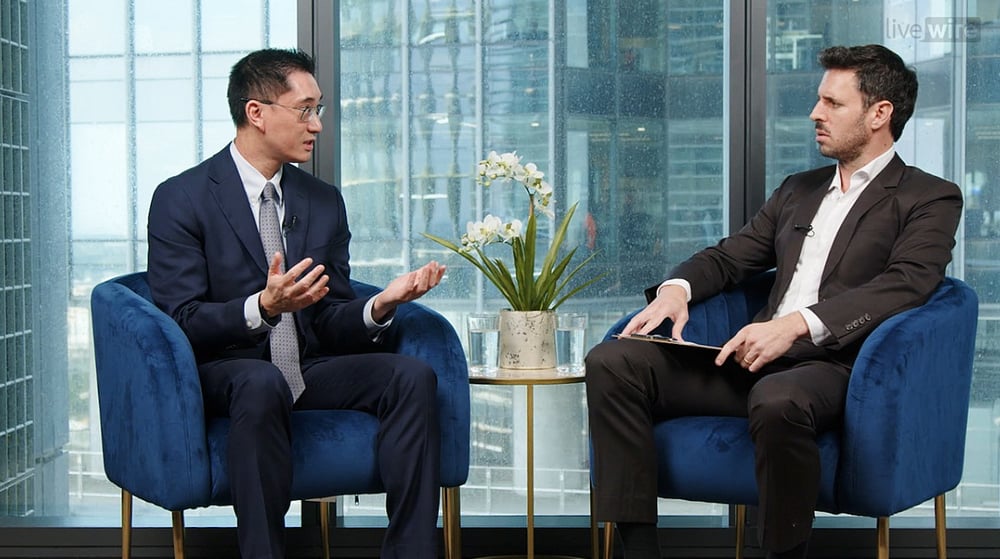
Macquarie Asset Management's Benjamin Leung talks to Livewire's Tom Stelzer
As portfolio manager Benjamin Leung explains, it's about trying to capture the compounding power of a consistent index-beating return, and offering that potential to more investors.
"This product was designed for an investor who appreciates the SAA [strategic asset allocation] process," says Leung. "They understand the separation of beta and alpha, they also appreciate that the market is not completely efficient and that going fully passive means that you're leaving a certain level of return on the table."
How systematic investing has changed with the times
A 25-year veteran at Macquarie - with a decade as the head of Systematic Investments - Leung has seen much in the way of change across markets, investors and the listed products space. The availability of data has driven a true evolution of how quantitative investing can actually work.
"From a systematic investor's perspective, the most impactful change is actually how the participants are observing the market," he says.
"If we cast our minds back to 15 years ago, you get your prices, you get your financial statements, and you fill in the gap with judgments. But today, there's so much data flying out from the system.
"The biggest impact that has on a systematic process like ours is really just the breadth of creativity that we can now bring to the investment process and also the nature of the talent that we can tap into to create successful investment outcomes."
Systematic investing is about leveraging all relevant data, analysis and insight in order to facilitate better results, says Leung.
"A systematic process is really the framework and the platform that creates the scale to ingest that data, to create a process that compounds the knowledge gain through that creativity and the common platform that allows individuals with different talents and different skills to work together."
"We're trying to create a repeatable outcome with a set of disciplined investment decisions. And to do that, we need to make sure that all the opportunities in the markets are looked at."
Crucially, a systematic approach hinges on the ability to iterate and optimise the strategy as markets evolve and become more complex.
"It is not a black box," says Leung. "Every decision has a very clear link from inception to action. It is also not set and forget. We are constantly looking at the efficacy of the model and the ability for that model to deal with the future. And ultimately, it is as active as any other investment approach that our investors will be accustomed to."
Looking to beat the benchmark
With many active investors struggling to keep pace with benchmarks and passive investors beholden to the broader market, there is a clear potential advantage to employing a systematic approach.
There are two aspects Leung thinks has created challenges for investors - the concentration of returns and the repeated concentration of that return, which leads to what he calls "outsized exposures" relative to the index.
"The challenge for the investor is that not only can they get this wrong, but the impact of being wrong is materially higher."
He uses the analogy of 10 playing cards lying face down. Two are red and eight are black, and the goal is to pick a red card. Not only is it difficult to pick a red card, there's also the opportunity cost of likely picking a black card instead.
A systematic approach, says Leung, allows Macquarie to turn over all the cards.
Three key edges to Macquarie's systematic strategy: its tenure, its risk capability and its unique alignment. On the first point, it's simply the accumulated experience of 30 years in markets.
"We know what works. We know what can break. We also know what sounds good in theory or marketing and not really effective in real life."
The second edge is what Leung describes as the "journey from a low risk capability to a high risk capability, " which has allowed them to build a solid foundation for focussing on risk management.
Like traditional investment management, we also do deep research, but we don't fall in love with our stocks.
The outcome of the systematic process is very small, deliberate bets that are paying attention to the prevailing markets, the risks that they bring to the portfolio, and the constant evolution of that process, which ultimately delivers the consistency that we're aspiring towards."
The third is a fee structure weighted towards performance, where Macquarie Asset Management "wins only when the investors benefit".
A headstart on AI
While investors, both retail and professional are still coming to terms with the impacts of AI across markets, their careers and broader society, for Leung and Macquarie Asset Management, it's a technology they are already extremely familiar with.
"The AI story is changing so rapidly and we're in a fortunate position to have an architecture and a team that's very comfortable with that technology," says Leung.
Machine learning is the "bread and butter" of Macquarie Asset Management's systematic approach, and the team are in an advantageous position in terms of getting the most out of the technology from a practical standpoint. AI tools are now used across various aspects of the strategy, including data processing, signal refinement and scenario analysis.
"Not only do we have the staff and the talent to utilise those tools, we have the culture and the processes that allow us to really leverage the outcome of those tools," says Leung.
"What we're most excited about is the actual acceptance that the technology is incredibly powerful and helpful in investment decision-making. And the advances in that technology can only allow us to do more and do things faster."
And that gets to the heart of what a systematic approach is all about - constantly evolving in an ever-evolving world.