BHP pays its lowest dividend since 2018. Here's what analysts are thinking
BHP posts record copper and iron ore production but profits slump 26% on lower commodity prices. Dividend beats estimates..

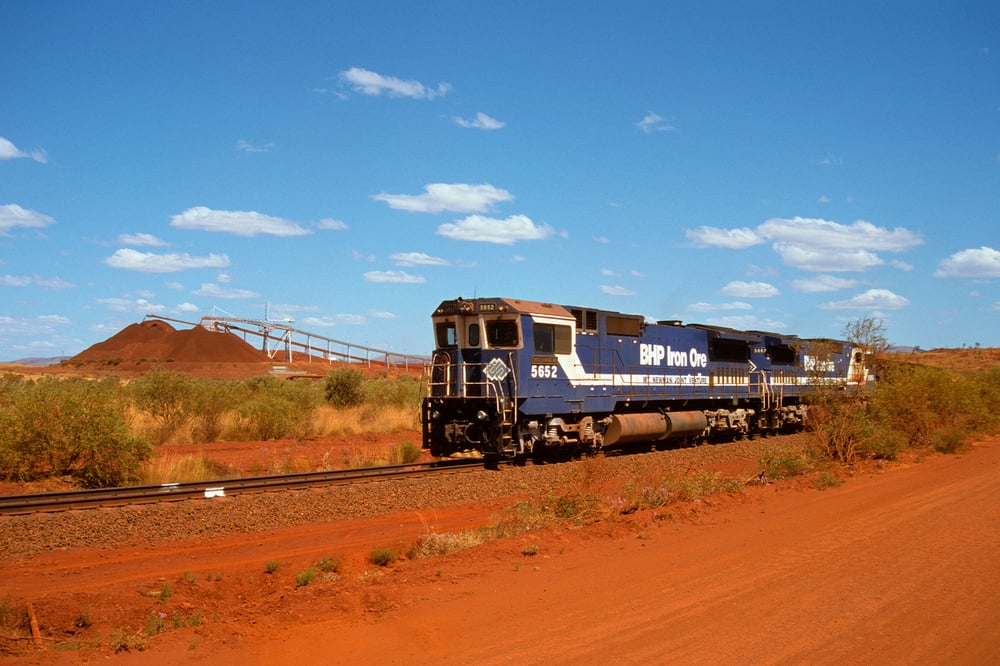
Source: iStock
Mentioned
KEY POINTS
- BHP achieved record copper and iron ore production but underlying profit fell 26% to US$10.2 billion due to lower commodity prices
- The company surprised investors with a 110 US cent dividend that beat estimates by 9% despite the earnings decline
- BHP expanded its net debt range to US$10-20 billion to fund growth projects while maintaining operational flexibility
BHP (ASX: BHP) reported a mixed bag of results on Tuesday, with record copper and iron ore production offsetting a sharp decline in profits as commodity prices weighed on the mining giant's bottom line.
While the company reported a rather sharp year-on-year decline in profits and dividends, it was largely within market expectations. The dividend, net debt and cash flow figures all came out stronger-than-expected.
FY25 key numbers
Revenue down 8% to US$51.3bn vs US$51.6bn estimates (1% miss)
Underlying EBITDA down 10% to US$26.0bn vs US$25.9bn estimates (in-line)
Underlying profit down 26% to US$10.2bn vs US$10.2bn estimates (in-line)
Total dividend down 25% to 110 US cents per share vs 101 cents estimates (9% beat)
Capex up 6% to US$9.8bn vs US$13.8bn estimates (29% beat)
Free cash flow down 55% to US$5.3bn vs US$4.2bn estimates (28% beat)
Net debt up 43% to US$12.9bn vs US$14.8bn estimates (13% beat)
Record production, low costs
Despite the earnings decline, CEO Mike Henry highlighted the company's operational achievement: "FY25 was another strong year for BHP, marked by record production, continued sector-leading margins and disciplined capital allocation."
The company set new production records in both copper and iron ore. Copper production exceeded 2 million tonnes for the first time, representing 28% growth over three years. BHP also maintained its position as the world's lowest-cost major iron ore producer, delivering a record 290 million tonnes from its Western Australian operations.
Mixed economic outlook
Henry outlined a cautious but optimistic view of global commodity demand. While expecting global growth to ease to ~3% amid shifting trade policies, he noted strong demand fundamentals, particularly from China and India.
"Chinese copper demand outperformed in FY25, while iron ore demand was resilient, driven by strong infrastructure investment and manufacturing activity in China," Henry said. The company expects potash markets to benefit from population growth and sustainable agriculture needs.
Macquarie's take
Macquarie highlighted several positive aspects of the results, including the 18% dividend beat driven by stronger free cash flow and the sale of the non-core Carajas asset. The analysts were upbeat on BHP's decision to increase its net debt target range from US$5-15 billion to US$10-20 billion.
"The re-prioritisation of capital and net debt increase were key positives. We think this supports higher returns in the future," Macquarie noted, lifting its target price by 5% to $43.00 while maintaining a Neutral rating.
The analysts also highlighted BHP's cost guidance for FY26, with beats across all key commodities including iron ore unit costs of US$18.25-19.75 per tonne.
However, concerns remain about the company's heavy capital investment in copper assets and the Jansen potash project. Macquarie noted that BHP's exposure to copper and potash has more than doubled, indicating significant capital commitments that may pressure near-term returns.
Capital allocation strategy
BHP is navigating the challenge of funding growth while maintaining operational flexibility. Macquarie believes BHP can absorb the approaching capital expenditure peak through FY29 within its expanded debt range, even as iron ore pricing faces pressure from new supply entering the market.

Source: Macquarie Research, August 2025
Citi took a more cautious stance, downgrading BHP to Neutral while maintaining its target price, citing concerns about the capital intensity of the company's growth projects.
Outlook
BHP has undergone a major transformation in recent years, lifting copper production, winding down coal and nickel operations, and set to become a major potash producer in FY27-28. But this transformation does not come cheap, with net debt soaring from US$9.9 billion in FY23 to US$12.6 billion in FY25. Despite the pockets of weakness around Jansen capex and commodity prices, BHP continues to deliver on strong operational outcomes.
Macquarie forecasts relatively mixed earnings growth for FY26-27, but expect the dividend to sit around the low US 100 cent level, representing a dividend yield of 3.8-4.4%.
FY25 | FY26e | FY27e | |
|---|---|---|---|
Revenue (US$m) | 51,262 | 46,497 | 44,249 |
Attributable profit (US$m) | 8,963 | 9,093 | 7,924 |
Net debt (US$m) | 12,635 | 12,139 | 12,057 |
DPS (US cents) | 110 | 117 | 101 |
Dividend yield (%) | 4.1% | 4.4% | 3.8% |
Source: Macquarie Research, August 2025
The FY25 dividend topped market expectations, with the company reiterating it takes its 50% minimum payout ratio "very seriously" and opted to pay out 60% of earnings due to the strong operational performance of the group.
The bottom line: BHP continues to deliver operationally sound outcomes, and remains a diversified proxy to iron ore and China, and a lessor extent, copper prices.