BHP overtakes CBA as ASX's most valuable company. Should you rotate out of banks?
BHP has overtaken CBA to become the ASX's most valuable company as surging commodity prices lift the miner to a record market cap.

Source: iStock
KEY POINTS
- BHP's market cap reached a record $257 billion, surpassing CBA's $251.5 billion as commodity prices surge.
- UBS research suggests rotating into cheaper bank stocks like ANZ and Westpac may not pay off when the top stock hits peak weight.
- Iron ore prices holding above US$105 a tonne have defied expectations of a decline to US$90, further supporting BHP's rally.
A commodity bull market has lifted BHP (ASX: BHP) past Commonwealth Bank to become the ASX's most valuable company for the first time since October 2024.
BHP shares have gained over 10% this year on strong iron ore prices and climbing copper, while CBA has fallen 6.5% to a nine-month low. BHP's market cap reached a record $257 billion today, edging ahead of CBA's $251.5 billion.
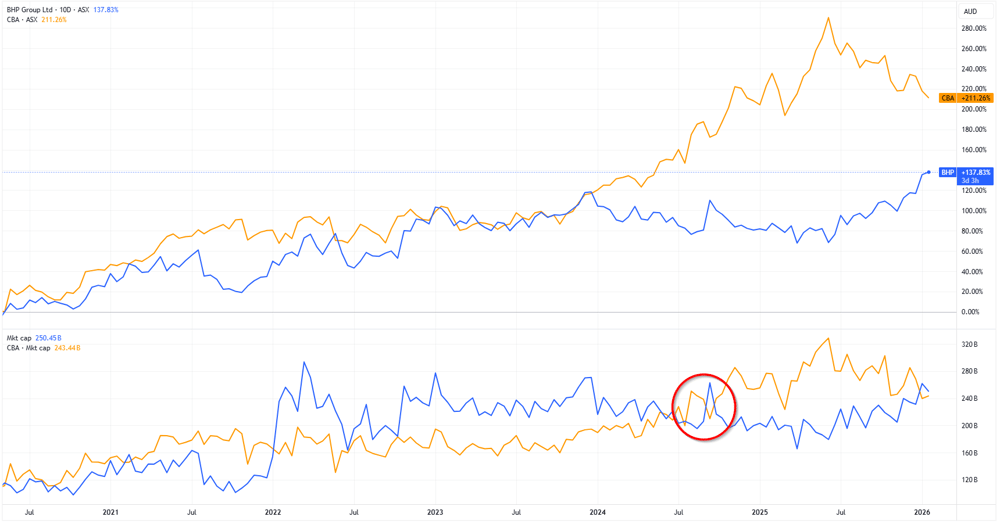
BHP vs. CBA share price returns (TOP) and market cap (bottom) | Source: TradingView
BHP has trailed CBA for most of this decade, except during 2022-2024 when it unified its dual-listed structure into a single Australian entity. That move lifted BHP's market cap and ASX 200 weighting from about 6% to nearly 10%.
"Once a stock passes its peak weight, best to avoid its entire sector"
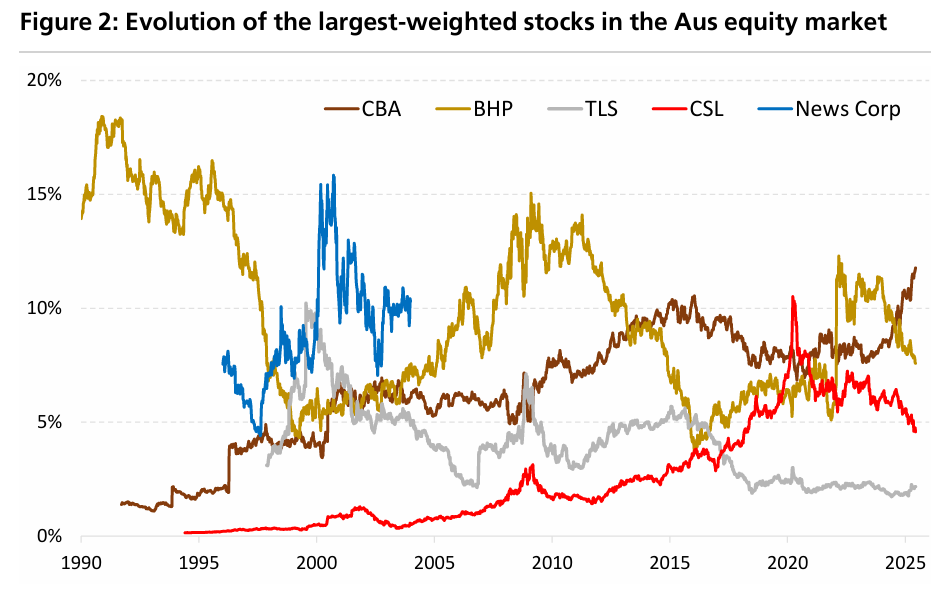
A June 2025 UBS research report found that "where #1 stocks hit their peak weight, we find that rotating towards the less peaky names within that sector has usually been a mistake."
This suggests that while ANZ and Westpac trade at lower multiples (PE of 18-20x versus CBA's 25x) and are executing fresh strategies under new management, rotating into them may not pay off.
"This was particularly the case following News Corp's peak weight moment in March 2000, as well as CSL's high point in March 2020."
News Corp's share price more than doubled during the dot-com bubble before a sharp correction, while CSL's peak weight preceded five years of sideways movement and three consecutive earnings misses in 2024-25.
"Instead, we find that comparable companies also underperform the market, and hence investors might have been better placed in rotating away towards the sectors that were not participants in the weight bubble," the analysts noted.
A fourth reign
BHP and CBA have traded the top market cap position since the 1990s. There is no real challenger beyond these two, with third-to-fifth placed ANZ, Westpac and NAB all valued at roughly half their size.
Source: UBS
Already in motion
BHP's ascent was set in motion during a broad resources rally. Our 52-week highs and lows series tracked the progression:
Gold stocks dominated the 52-week highs list for most of early-mid 2025
By mid-October, the rally began to broaden and feature copper and rare earth names like Lynas, Sandfire Resources and Capstone Copper
Around the same time, iron ore and lithium stocks like Rio Tinto, Liontown and MinRes started to break yearly highs
In early November, high-profile names like Fortescue, BHP and IGO also pushed into 52-week high territory
Come 2026, the rally featured some fairly slow-moving and/or battered names like South32 and Nickel Industries
In late October, the Bloomberg Commodity Index – which tracks 22 commodity futures across energy, metals and agriculture – broke out after almost three years of sideways action.
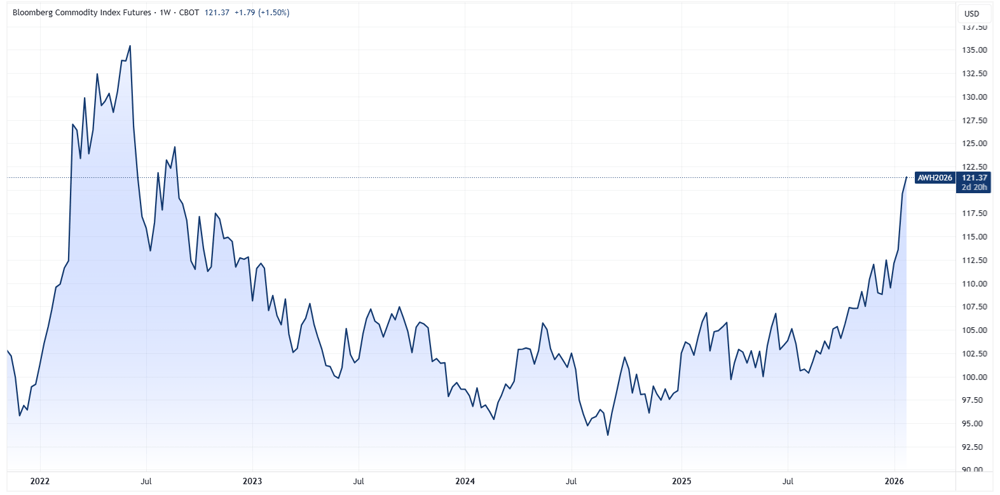
Bloomberg Commodity Index (Source: TradingView)
The momentum behind the commodity trade is hard to ignore.
As the market's largest resource stock, BHP reclaiming the top spot was a matter of time (which was also supported by CBA's valuation coming back to earth). While diversified, BHP remains primarily an iron ore miner with exposure to copper, potash and nickel.
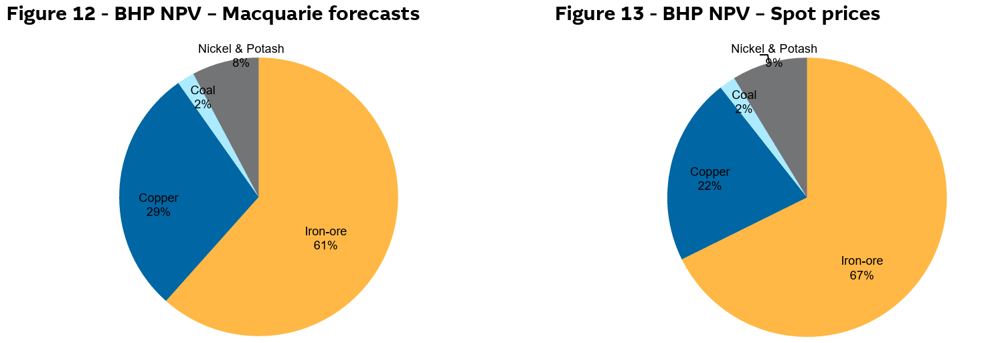
Source: Macquarie Research, January
With iron ore holding above US$105 a tonne (defying expectations of a drop to US$90) and tailwinds across its other commodities, this may signal a new era for the resource sector.