BHP at all-time highs: Is the Big Australian getting expensive, or just getting started?
Copper now drives most of BHP's earnings, and a worsening supply squeeze is why the miner's pricey-looking multiple may still be cheap.

Source: iStock
Mentioned
KEY POINTS
- BHP's trailing PE has expanded to about 25x, but copper now drives 54% of group EBITDA, up from 21% in FY22, reshaping how the stock should be valued.
- Copper supply is deteriorating across the chain, with miners from Antofagasta to Freeport cutting 2026 guidance on storms, floods and falling grades.
- BHP is targeting a 50% copper output lift by the mid-2030s and delivered a 172 US cent FY26 dividend at a 66% payout, ahead of the 63% consensus.
BHP (BHP) is up almost 50% year-to-date, outpacing everything in the S&P/ASX 100 bar Codan and most of the S&P 500 too, except for a handful of chipmakers.
However, since 2020 BHP's multiple has actually expanded from around 10–18x to 25x today (trailing price-to-earnings). In other words, share price appreciation has outpaced earnings growth. Another way to look at it is that you almost never see BHP this expensive.
In saying that, the BHP we know today is structurally different from the BHP of old, having offloaded its petroleum assets in 2022 and acquired Oz Minerals in 2023. Go back further and BHP even had line items for diamonds, manganese, aluminium and thermal coal. In the latest FY26 result, copper contributed 54% of Group underlying EBITDA, compared with 21% in FY22, 17% in FY17 and 14.5% in FY13.
You've now got a mining conglomerate far more focused on four key pillars (iron ore, coal, copper and potash), with a majority of earnings derived from a metal that has a rather asymmetric outlook. Consensus is that copper markets will face a growing deficit, thanks to a lack of new mines and the challenges existing developers and producers face getting projects up and running. This year alone, copper is up 16% and trading near record highs of US$6.7/lb. Contrast that with the BHP of old, where most earnings came from iron ore, a commodity most consensus forecasts expect to dwindle towards US$60–70 a tonne over the medium to long term.
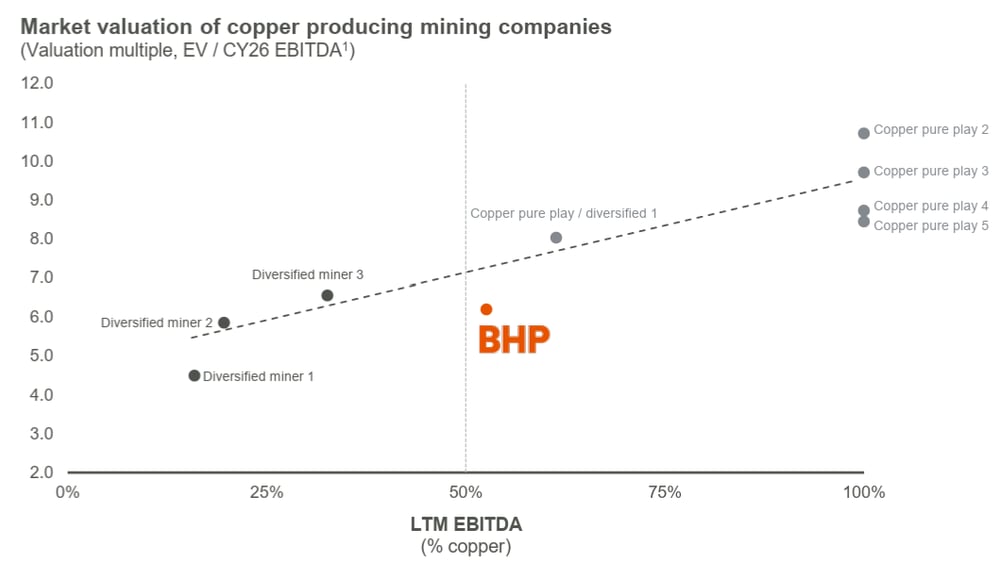
One of the more interesting slides from BHP comes from the 1H26 result back in February, where the company argues that multiples for copper pure-play companies have risen from 6.5x to 9.5x over the past three years, while BHP trades on around 6x despite copper now crossing the 50% mark for Group earnings.
Source: BHP 1H26 results presentation
So with that in mind, yes, BHP's multiple has expanded to levels typically associated with it being 'expensive'. But those historical comparisons are difficult, as the company is far more future-facing today and leveraged to one of the best-performing commodities of the year, copper.
To close out this piece, here are three reasons why BHP is just getting started.
#1 Copper backdrop
Forecasts for the global copper market in 2026 are all over the place. Morgan Stanley has a 590kt deficit and J.P. Morgan a 330kt deficit, while Macquarie sees a 262kt surplus and Goldman Sachs a 490kt surplus. That is a spread of more than a million tonnes on a market of about 28 million tonnes, which says more about how little anyone trusts the disruption assumptions than it does about demand.
The IEA warned in July that global primary copper supply could face a 25% deficit by 2035 on current policy settings, with average ore grades down 40% since 1991 and only 5% of the world's known deposits discovered in the past decade.
But look at the production outlook for the major miners and it's no wonder copper markets are getting increasingly tight.
BHP June quarter copper output fell 5% to 491.9kt on weaker Escondida and Pampa Norte, with FY26 landing at 1,953kt and a sharp FY27 step-down to 1,650-1,800kt on forecast Escondida grade decline.
Freeport-McMoRan (23-Jul) Q2 copper production fell 18% to 357kt year-on-year, or 786 million pounds.
Ivanhoe Mines (30-Jul) Q2 copper in concentrate fell 45% to 61kt from 112kt a year earlier, and the company tightened 2026 guidance to 290-310kt from 290-330kt.
Codelco chairman Bernardo Fontaine sees no path to the prior 1.7Mt target within four or five years, warning of another tough production year at the world's largest copper miner.
Zijin Mining said its full-year copper target was under pressure after flooding at Kamoa-Kakula on 24 August.
MMG suspended Las Bambas in Peru after a fatal accident on 18 August killed two workers. The mine produced 410,829t in 2025 and accounts for roughly 2% of global mined supply.
Lundin Mining cut Caserones 2026 guidance to 120-130kt from 130-140kt after a second Atacama winter storm knocked out power on 19 August
Antofagasta cut 2026 guidance on 13 August to 625-655kt from 650-700kt after extreme rain and snow shut Los Pelambres, an event that prompted Chile to declare a state of catastrophe in Coquimbo.
Copper deficit and surplus forecasts vary dramatically, and the metal remains sensitive to the ebb and flow of global industrial activity. But new supply has struggled across the whole chain, from discovery through construction to operating mines. Fewer deposits are being found and grades keep falling, projects in development see their capex blow out and existing producers have spent 2026 cutting guidance down for reasons ranging from Chilean storms to seismic risk.
#2 Copper growth ambitions
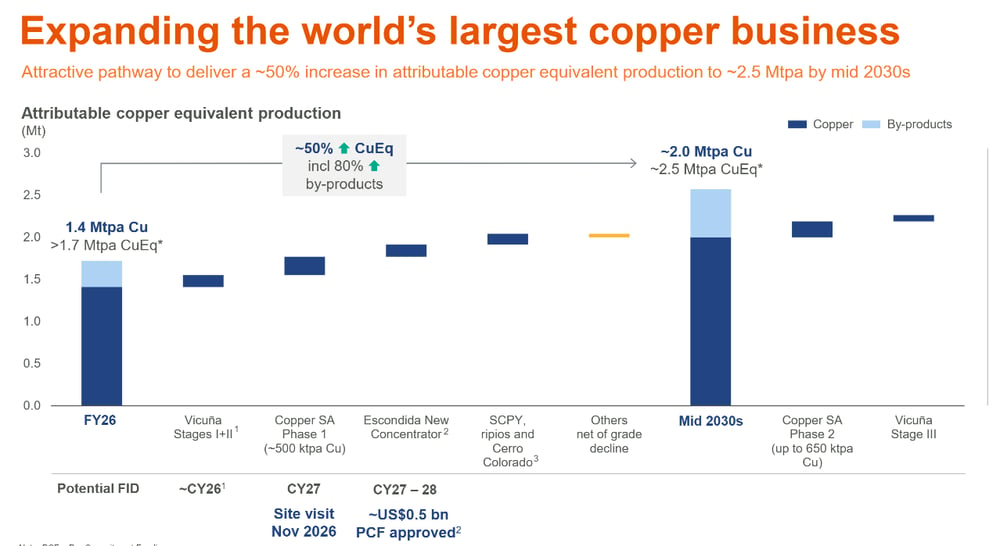
BHP says it has an attractive pathway to deliver a 50% increase in copper production by the mid-2030s. That growth outlook comprises
Vicuña Stages I and II: 50/50 joint venture with Lundin Mining spanning the Argentina and Chile border. Stage 1 is the Josemaría open pit plus a sulphide concentrator at 175,000tpd nameplate, roughly US$7bn capex spent from 2027, first production targeted 2030.
Copper SA Phase 1: Olympic Dam, Prominent Hill and Carrapateena feeding a centralised smelter and refinery at Olympic Dam. Phase 1 converts the smelter to a two-stage configuration better matched to the ore mineralogy.
Escondida New Concentrator: Replaces the ageing Los Colorados plant, which is near end of life and will be demolished.
Source: BHP FY26 results presentation
It's a nice slide about the growth opportunity at hand, but execution is the hard part. BHP has already blown out its Jansen Potash Stage 1 budget, with capex soaring to US$8.4 billion vs the original US$5.7 billion approval in 2021.
If you're looking for copper-specific examples, Teck Resources' Quebrada Blanca Phase 2 (QB2) was sanctioned at US$4.7 billion in December 2018, with first production targeted for the second half of 2021. Teck raised the cost roughly six times, to a final US$8.6 billion or 85% above the original forecast, and the first concentrate shipped in 2Q23.
#3 Shareholder returns
BHP has a minimum dividend payout ratio of 50% of underlying profit in every reporting period. The latest result delivered an FY26 dividend of 172 US cents at a payout ratio of 66%, vs 63% consensus. That's a ~3.5% dividend yield at today's prices (it was close to 4%, but the stock has rallied a bit too much in the past week).
The better-than-expected dividend comes at a time when BHP's net debt has fallen below US$9 billion, under its US$10–20 billion target range. As CFO Vandita Pant puts it, "We have plenty of room to fund our exciting growth programs around the globe."
The bottom line: Copper is trading at record highs despite a volatile macro backdrop and the threat of Trump tariffs on refined copper. Nobody knows where demand will land, but supply continues to deteriorate and it's squeezing the market tighter. One capex blowout or production downgrade is a problem at the company level. But sector-wide, the development delays, cost overruns and guidance cuts have flipped into something closer to a tailwind for the metal itself. Could bond yields, oil prices or a wobble in the AI trade push copper lower in the near term? Absolutely. But lower prices disincentivise the very production the market is already short of, which only tightens things further. Hence why the term 'asymmetric' keeps getting thrown at copper.