BHP and China's iron ore standoff is over, is it time to buy?
China's state iron ore buyer has reportedly lifted its ban on BHP iron ore. Can investors now buy with confidence? What the experts say.

Source: Shutterstock
Mentioned
KEY POINTS
- China's state-backed iron ore buyer banned certain BHP iron ore products in September last year in a bid to reshape iron ore pricing, a dispute that has cost BHP hundreds of millions.
- Reports now suggest the ban has been lifted following a visit to China by BHP's incoming CEO. Discounts on BHP's key iron ore products have already begun to narrow, but a final resolution on pricing may be elusive.
- This article breaks down the dispute, what's changed, and what the major brokers make of BHP's updated outlook. Buy, hold, or sell the Big Australian? Let’s find out!
For much of the past seven months, BHP Group (BHP) has been caught in a slow-burning pricing dispute with one of China's most powerful commodity buyers — a dispute that eroded hundreds of millions of dollars in potential earnings.
Now, with reports emerging that the ban has been lifted following a high-level visit to Beijing by BHP's outgoing and incoming CEOs, investors are asking two questions: how bad is the damage, and is BHP now a buy?
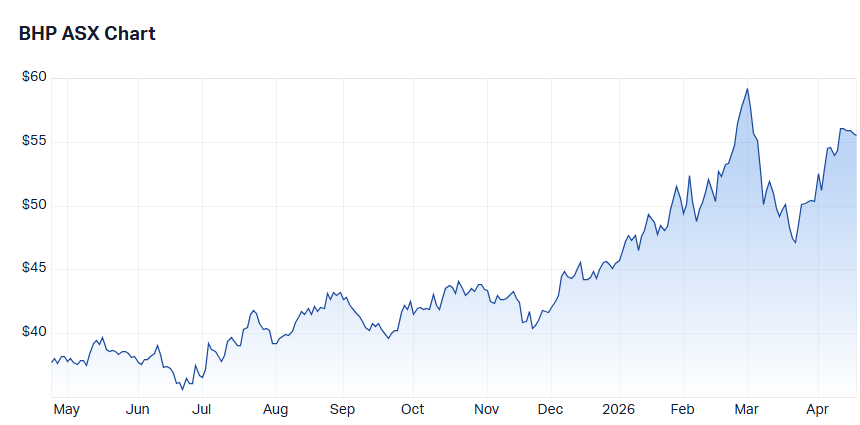
BHP share price
This article will investigate the reasons for the spat, what a resolution likely means for BHP's earnings outlook, and where the major brokers stand on the stock right now.
Breaking up is hard to do
In September 2025, China's Material Resource Group — known as CMRG, the state-backed body that coordinates iron ore procurement on behalf of Chinese steel mills — imposed a ban on purchases of BHP's Jimblebar fines, one of the miner's key Western Australian Iron Ore (“WAIO”) products. Jimblebar fines represent approximately 25% of BHP's total WAIO export volumes, making it a substantial earnings driver for the company.
CMRG's motivation was highly strategic. The ban was designed to pressure BHP into accepting new price-setting mechanisms that would lower the cost of raw materials for Chinese steelmakers — a long-running objective of Beijing's commodity policy that aims to reduce the country’s dependence on Australian-benchmark priced iron ore.
As a result of CMRG’s bans, BHP's Jimblebar fines moved to a discount of around 10% to the 61% Fe benchmark during the December 2025 and March 2026 quarters — wider than the 7-8% discounts seen before the ban. Investment bank UBS estimates the pricing impact could have cost the company in the vicinity of US$300 million in EBITDA over the last two quarters.
Importantly, UBS's shipment data — sourced from its Evidence Lab's Global Maritime Cargo Monitor tracking over 35,000 commercial vessels — showed no meaningful disruption to actual export volumes. Banned BHP cargoes were redirected to other buyers, with global trade rebalancing around the restriction. This suggests the damage was in price, not volume.
The broader context matters too. The dispute landed during a period of elevated geopolitical tension between Australia and China across multiple commodity categories, then colliding with the Middle East conflict which drove energy and shipping costs higher, adding freight cost pressure on top of the discount headwind.
C-suite diplomacy triggers a thawing of relations
The reported breakthrough followed a visit to China by BHP's incoming CEO Brandon Craig alongside outgoing CEO Mike Henry, who met with executives from CMRG and major Chinese steel producer Baowu. According to media reports, CMRG has allowed domestic steel mills to resume purchasing BHP cargoes denominated in US dollars, and it has also permitted delivery of BHP cargoes previously held at Chinese ports.
The early pricing data is encouraging. Jimblebar fines discounts have already tightened from approximately 11% the week prior to around 7% — back in line with the March 2026 quarter average and consistent with pre-dispute norms.
But as UBS observes, a final resolution to the CMRG-BHP pricing negotiations is likely to involve some form of new pricing arrangement — and that outcome may actually weaken overall price realisations slightly for BHP. There are also significant ramifications for BHP’s competitors Rio Tinto (RIO) and Fortescue (FMG) whose realisations had been artificially supported by the CMRG-BHP spat.
Even with a final resolution still in the works, the lifting of the ban is arguably a positive for BHP's operational standing, and it removes a key overhang on the stock. But it’s also very likely that the endgame of a negotiated settlement will involve at least a modest structural concession on pricing terms. The net result is likely still positive — and the uncertainty discount should compress — but this is not a clean, uncomplicated win for BHP management.
What do the brokers think about BHP now: Buy, Hold or Sell?
The CMRG resolution removes the single largest stock-specific overhang on BHP that has persisted since September 2025. Here's where the major brokers stand with regard to the stock now:
%20Broker%20Consensus,%2021%20April%202026.png)
BHP Group (BHP) Broker Consensus, target price versus close price on 21 April of $55.51.
To obtain a stock’s Broker Consensus Rating, we assign a value of +1 to any rating better than HOLD/NEUTRAL/MARKETWEIGHT, a value of 0 for any rating equivalent to HOLD/NEUTRAL/MARKETWEIGHT, and a value of -1 to any rating worse than HOLD/NEUTRAL/MARKETWEIGHT.
We then take the average of all assigned rating values and assign a Broker Consensus Rating of BUY to values greater than +0.5, a rating of HOLD for values between -0.5 and +0.5, and a rating of SELL for values less than -0.5.
The Broker Consensus Target is simply the average of the target prices we have on file for each broker. Typically, brokers define their target prices as a 12-month forecast. Each target price is based on fundamental valuation assumptions.
BHP’s Broker Consensus Rating is +0.45, resulting in a Broker Consensus Rating of HOLD. Its Broker Consensus Target is $55.10. This suggests brokers collectively believe the stock is around 0.7% overvalued based upon its closing price on Tuesday 21 April of $55.51.
Conclusion: Time to kiss and make up
Most analysts agree that the CMRG-BHP dispute was never really about Jimblebar fines. It was about China asserting pricing power in a commodity market it dominates on the demand side — and that Australian iron ore majors BHP, RIO and FMG dominate on the supply side.
Why target BHP? China’s beef with BHP likely stems from the company’s 2010 move, led by then-CEO Marius Kloppers, away from long-term benchmark pricing toward spot pricing. History shows the switch has favored miners substantially, and at the expense of Chinese steel industry profits.
BHP has made another strategic calculation — that a managed de-escalation serves both parties better than a prolonged standoff. The fine print of any final pricing agreement warrants watching, but in the meantime, the consensus among the experts is that BHP shares sit on the cusp of a buy, with the CMRG resolution a potential catalyst to push it over the line.
This article draws on institutional research from UBS Global Research (April 2026).