Australia’s fastest property downturn in 40 years has further to fall, economists warn
House prices are falling fast, but buyers’ borrowing power is shrinking even faster, and economists don’t see a bottom until well into 2027.

Source: ChatGPT
Mentioned
KEY POINTS
- House prices rose almost every month for three years, peaking at a record high in March.
- Five interest rate hikes and investor tax changes have sent lending and prices into a record-breaking slide.
- This article looks at where economists see the bottom, which ASX sectors are most exposed.
Australian home values rose in all but three months between February 2023 and March 2026, where they climbed to a record high. Strong population growth, tight housing supply and pent-up demand drove the supercycle. But this year has firmly put that cycle in reverse, with five interest rate hikes from the Reserve Bank of Australia (RBA) and a Federal Budget crackdown on investor tax breaks. National values have now fallen for seven consecutive months to sit 6.7% below their March peak.
And the data keeps getting worse. On Wednesday, the Australian Bureau of Statistics (ABS) reported that the value of new home loans fell 15.5% in the September quarter, almost double the 8% fall economists expected and the largest quarterly drop since the series began in 2002. Cotality figures released the same day show capital city values have fallen 8.1% in seven months, the fastest decline in at least 40 years, and are set to surpass the largest peak-to-trough fall of the past four decades next month.
This article explains why lower prices have done little to improve affordability, and how far economists expect the downturn to run before the market finds a bottom. It also looks at which parts of the ASX are most exposed.
Why cheaper homes aren’t more affordable
Falling prices should make housing cheaper, but most buyers are limited by how much a bank will lend them, not by the price of the home. Higher rates lift repayments and reduce the size of the loan a bank will approve. Cotality estimates a median-income household can now borrow about $88,000, or 12%, less than in January. National prices have fallen 6.7% since March, which leaves the typical buyer able to afford less than at the peak.
In a recent note, Macquarie estimated that average prices are almost 30% higher than a typical household can afford. Even after a 10% fall from the peak, prices would still be about 25% too high at the end of 2027 if rates stay at 4.85%. The gap can only close through some mix of lower prices, higher incomes and lower interest rates, and on Macquarie’s numbers income growth alone would take about eight years.
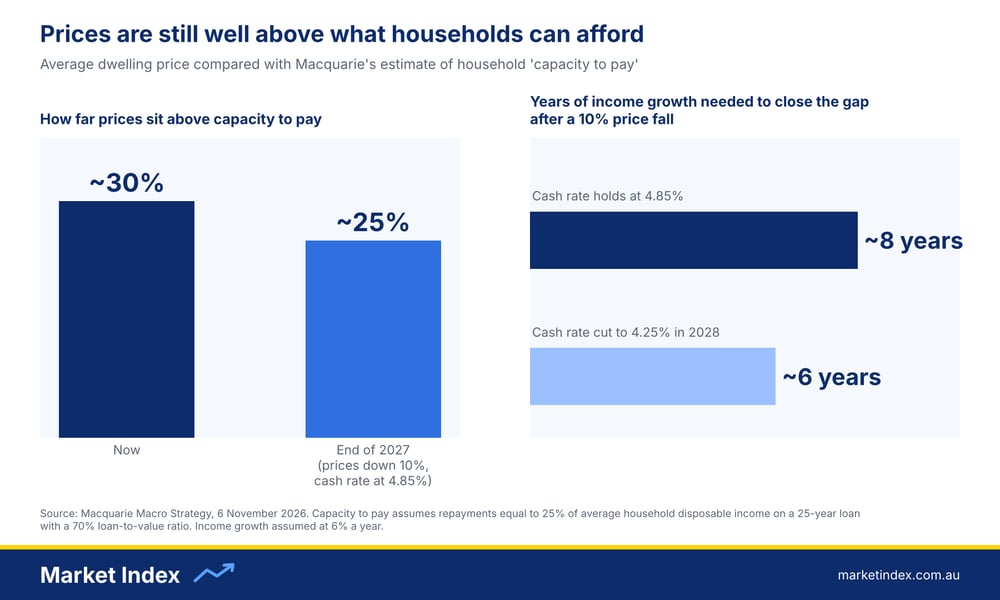
Capacity to pay assumes repayments equal to 25% of average household income on a 25-year loan with a 30% deposit, and income growth of 6% a year. Source: Macquarie
First home buyers, who would normally step in as investors retreat, are also pulling back. Their lending fell 8% in the September quarter, and in a note published on 11 November, UBS warned that prices need to fall further before first home buyers can “fill the hole” left by investors.
When owning a home costs far more than renting one, renters have little reason to buy and demand stays weak. In a November note, Morgan Stanley found the gap between the two is the widest since its data began in 2005. In past downturns the gap closed around the time prices bottomed, usually with help from lower interest rates.
Where is the bottom in the Australian property market?
Housing is a momentum market, where falling prices make buyers wary and keep prices falling until something changes the outlook. Morgan Stanley has identified five signals that marked every housing trough since 2008:
Markets pricing in rate cuts
Governments easing housing policy
Sales rising relative to listings
Auction clearance rates turning higher
The cost of owning falling relative to renting
At least three were present at each trough, and none has been triggered in the past 10 months. Markets are pricing only a small chance of another rate rise early next year and no cuts until the second half of 2027. Government policy has tightened, through the investor tax changes and limits on high debt-to-income lending from the banking regulator, the Australian Prudential Regulation Authority (APRA).
Activity is still weakening, with Cotality data showing the four-week average auction clearance rate across the capitals fell to 44% at the start of November, its lowest since May 2020 and below the roughly 50% Morgan Stanley treats as a turning point. Owning also remains far more expensive than renting.
Morgan Stanley does not expect the signals to line up until mid-2027. It forecasts a 10–15% fall from the peak, with a trough in the second half of 2027, which would be the largest fall in nominal terms since Cotality’s records began in 1980. UBS now expects a fall of about 13%, up from 10%, with a bottom around November 2027. Morgan Stanley sees one possible catalyst in the May 2027 Federal Budget, which could include support for first home buyers once prices have fallen by double digits.

Illustrative paths applying Morgan Stanley and UBS peak-to-trough forecasts to the ABS March quarter peak. ABS data runs to June; Cotality shows national values 6.7% below their March peak by the end of October. Source: ABS, Cotality, Morgan Stanley, UBS
How the housing downturn will impact ASX shares
Consumer discretionary stocks are the most exposed. Morgan Stanley found that spending on furniture, cafes and restaurants fell furthest in past downturns, while food spending held up best. UBS said that recent updates from listed companies show the consumer starting to weaken sharply.
Residential construction is the next channel. Morgan Stanley expects dwelling investment to fall about 3.3% through 2027, as higher rates, lower prices and rising building costs squeeze the economics of new projects. Developers are already responding. Morgan Stanley pointed to Stockland’s (SGP) October update, which showed falling residential sales and early signs of rising incentives and discounts. Builders exposed to data centres are better placed, with approvals for the commercial buildings UBS uses as a proxy for data centres up about 125% on a year ago.
The banks face slower growth rather than a wave of bad debts. Macquarie expects housing credit growth to slow to around 4% annualised as fewer homes change hands, while strong competition for mortgages keeps margins low. Loan impairments remain low despite recent increases, and the RBA estimates fewer than 1% of borrowers owe more than their home is worth.
Conclusion
Economists aren’t expecting the bottom of this downturn any time soon, though homeowners can take some comfort from markets pricing little chance of another rate rise. Anyone with money tied up in housing, whether through a mortgage or ASX-listed retailers, builders and banks, will be watching for the critical signals of a housing market trough we’ve identified here to start flashing. On the current data, they should brace for a longer wait, with the full sting of this year’s rate rises yet to be felt.