ASX Stock Scores: The #3 ranked stock that's paid a 20% dividend yield
Helia ranks #3 on Stock Scores despite losing a massive CBA contract. Here's what's propped it up, and the risk from falling house prices.


Source: Generated with Gemini
Mentioned
KEY POINTS
- Helia ranks #3 on Stock Rank despite a 44% fall in first-half gross written premium, a measure of the new insurance business it's writing, largely due to losing a key CBA contract
- Helia holds about twice the capital APRA requires, well above its own target, which funded a 22.9% dividend yield in FY25, with three-quarters of it paid as special dividends
- Macquarie has largely rated Helia Underperform since March 2025, but the stock has returned around 45% including dividends since then and trades within 8% of its all-time high
Looking for your next idea? Market Index's new Stock Scores ranks more than 1,800 ASX companies on value, quality, momentum, dividends and growth, making it the easiest way to uncover stocks worth a closer look. You can find out more about Stock Scores here.
This weekly series will take a closer look at individual stocks of interest from the various scans. Today, we’re looking at Helia – which sits at #3 across Stock Rank, an overall rank factoring in value, quality, momentum and growth.
Helia Group (HLI) is Australia’s largest specialist provider of Lenders Mortgage Insurance (LMI). At first glance, you’d be surprised to see Helia rank so highly, considering the sheer number of headwinds the company has faced in a short span of time.
March 2025: Announced that CBA had entered into exclusive negotiations with a rival provider, meaning their 50-year relationship would wrap up at the contract's expiry on 31 December 2025. CBA accounted for approximately 44% of Helia’s FY24 GWP. The stock tumbled 25.5% on the day (24-Mar-25)
To make matters look worse, then-CEO Pauline Bright-Johnston sold approximately 393,000 shares in late-February and mid-March, valued at approximately $2.6 million just days before the CBA news
July 2025: ING Bank Australia was also moving to an alternative provider, accounting for roughly 17-20% of Helia’s GWP. The stock tanked 21.3% on the day (2-Jul-25).
This triggered an intense internal review, culminating in Helia successfully winning back the ING business with a new agreement starting in mid-2026
This is on top of how the government's 5% Deposit Scheme has effectively absorbed most of the first-home buyer market (since they act as the guarantor), a cool down in the Australian property market and major Australia banks choosing to hold the risk on their own balance sheets. And when you look at Helia’s latest first-half FY26 result on 11 August, it doesn't read all that bullish.
Gross written premium down 44% year-on-year to $61.6m
Underlying net profit after tax down 16% to $106.3m
Ordinary dividend flat at 16 cps
So what gives? Two things have kept it together for Helia – an abnormally strong capital position and years of releases from its claim reserves.
Special dividends doing the work
Helia holds far more capital than the regulator requires, and that surplus keeps growing as the business shrinks, while the rest remains very profitable.
APRA sets a minimum capital level for insurers, called the Prescribed Capital Amount (PCA). Helia's board targets 1.40 to 1.60x PCA, and anything above that is surplus it can return to shareholders. At 30 June, Helia's regulatory capital was 2.07 times PCA, so it was still well above the top of its range, even after years of payouts.
It has been above the range for some time:
1.86x at FY23
2.10x at FY24
2.03x at FY25
2.07x at 1H26
Helia has a strong track record of returning some of its excess capital back to shareholders in the form of a (massive) special dividend. Between FY23-25, the stock has effectively yielded 55.1% (not a typo). Even after the FY25 payout, the PCA barely moved due "to a fall in the regulatory capital requirement as in-force run-off and seasoning exceeded capital requirements for new business."
Financial year | Total Ordinary | Total Special | Total Dividend | Dividend yield |
|---|---|---|---|---|
1H26 (declared) | 16 cents | 27 cents | 43 cents | TBD |
FY25 | 32 cents | 94 cents | 126 cents | 22.9% |
FY24 | 31 cents | 53 cents | 84 cents | 18.7% |
FY23 | 29 cents | 30 cents | 59 cents | 13.5% |
Source: Market Index
In dollar terms, the current safety buffer equates to roughly $350-400 million in pure surplus capital (benchmarked against historical PCA filings where a 2.1x ratio represented ~$415m in excess buffer).
Once you adjust Helia's price chart for dividends, it's actually in a pretty smooth uptrend.
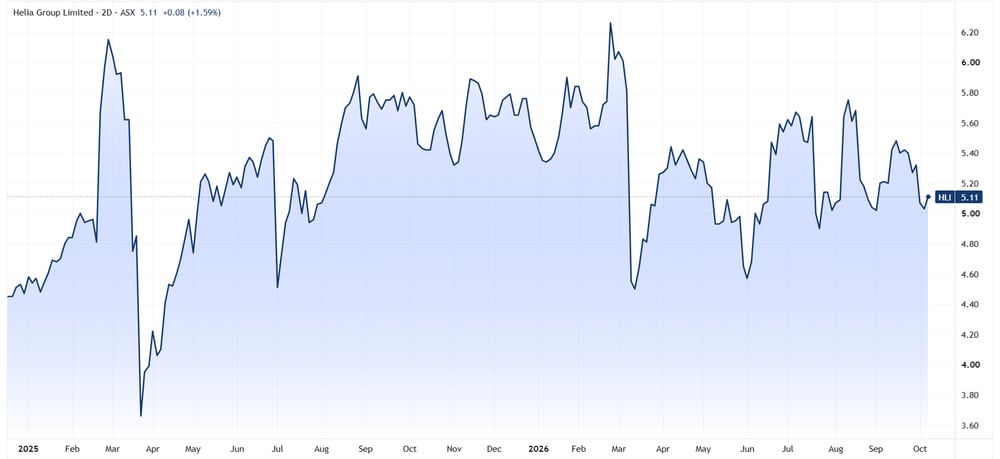
Helia price chart (Source: TradingView)
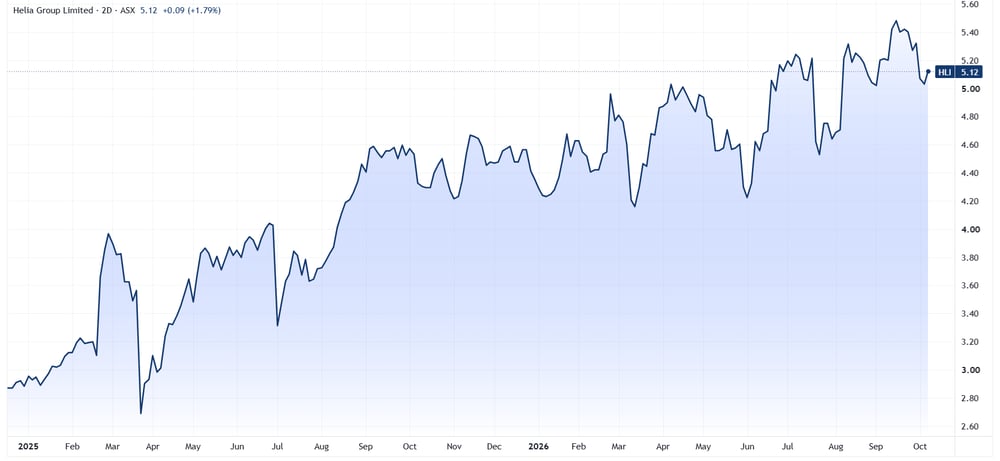
Helia price chart adjusted for dividends (Source: TradingView)
Rising house prices let Helia cut its reserving basis for several years. Claims reserves is money set aside for loans in arrears, and when those borrowers sell or refinance their way out, the excess goes back into profit. Macquarie's figures show Helia released reserves in almost every half since 2021, about $150 million in net releases.
A tough road ahead
So far, you've got a business that's lost a sizeable chunk of GWP, but that's not actually a bad thing. What's left is still highly profitable, and rising house prices leave Helia with both excess capital and reserve releases. Its capital remains well above regulatory requirements, which likely paves the way for more special dividends in the near term.
But the same can't be said for reserve releases.
Cotality data shows national home values fell 1.1% in September, a sixth straight month of declines, and are now down 5.2% from their March 2026 record high. Helia's own sensitivities, from its annual report note:
A 5% fall in house prices adds about $11m to claims reserves
A 1% rise in mortgage rates adds about $7m
A 1% rise in unemployment adds about $5m
Putting it all together
Helia sits at #3 on Stock Rank, with its value, quality, momentum and growth scores all between the 89th and 97th percentile of ASX companies.
It trades on a normalised trailing P/E of 5.5x, well below the sector and market average, while quality metrics like ROE, net profit margin and free cash flow are well above. Once adjusted for dividends, the price chart is in a strong uptrend. So on a backward-looking basis, the stock ticks a lot of boxes.
Looking forward, Helia doesn't have much going for it beyond its capital position. But that's been the case for quite some time. Macquarie has largely rated the stock Underperform since March 2025, and over that time, it's rallied around 45% (total return basis). Even with house prices slumping, it's trading within 8% of its all-time high.
Macquarie expects the company to pay another 80 cent special dividend in FY27. That's a yield of about 16% at today's price of $5.10. If Helia does fall towards the mid $3s, the same special would yield more than 20%, which I guess provides something of a floor for the share price.