ASX 200 posts worst session since November as risk-off selling hits all sectors
ASX 200 falls 2% with only eight stocks rising as commodity prices tumble and tech fears grip markets in worst session since November.

Source: Shutterstock
KEY POINTS
- Only eight S&P/ASX 200 constituents are trading higher as the index falls 1.98%, with the Tech Index down 43% from its September peak and the Emerging Companies Index shedding 15% over 10 days
- Commodity prices tumbled overnight with silver down 19.5%, platinum falling 10.4% and gold dropping 3.7%, driving broad-based selling across Australian resource stocks
- Despite near-term technical weakness, ASX earnings are projected to grow 8-9% in both FY26 and FY27 after three years of flat growth, while S&P 500 companies are posting 11.9% earnings growth vs. market expectations of 8.3%
The S&P/ASX 200 is trading sharply lower amid broad risk-off selling that has left every sector in the red and the index back at breakeven for the year.
The weakness follows a downbeat session on Wall Street, where the S&P 500 fell 1.23% back into negative territory for 2026. Mega cap tech stocks led the decline, with Microsoft down 4.9% and Amazon falling 4.4%.
Commodity markets also finished sharply lower overnight. Gold dropped 3.7% to US$4,776/oz while copper fell 3.5% to US$5.73/oz. Equities in the nickel, uranium, lithium and rare earth space tumbled 4-6%.
The ASX 200 is currently down 1.98%, marking its the worst session since 18 November 2025 when the index fell 1.94% in a tech and resource-led selloff. Despite the headline decline, things are looking far worse beneath the surface.
Breadth deteriorates
No sector has been spared, with Healthcare and Staples down the least, while Tech continues its sharp decline. Only eight S&P/ASX 200 constituents are trading higher.
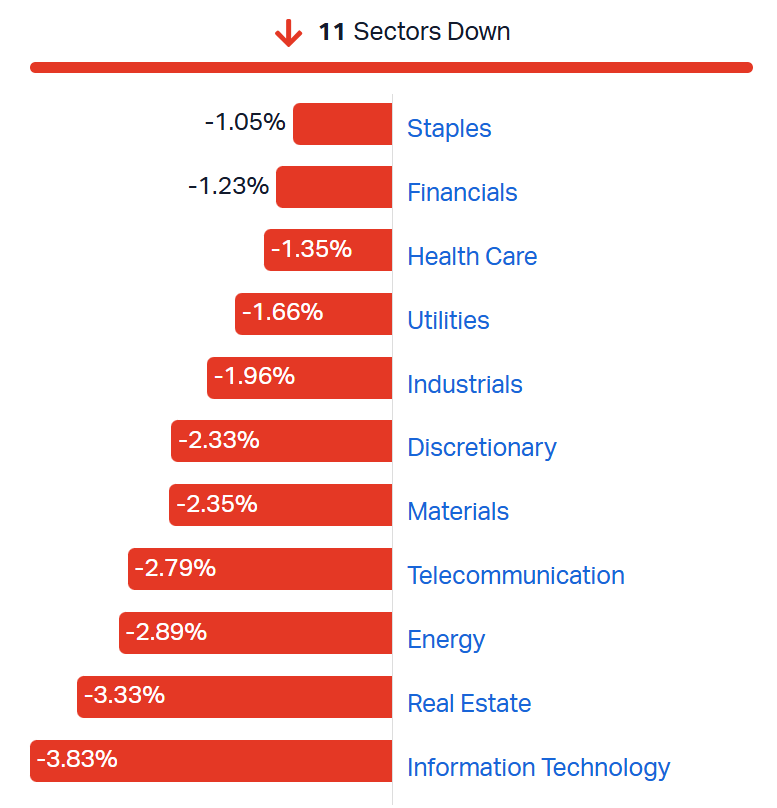
S&P/ASX 200 sectors at 3:00 pm AEST
Risk benchmarks under pressure
While the index is down 1.9%, more risk-sensitive and growth-oriented pockets of the market are under significantly greater pressure.
The S&P/Emerging Companies Index has fallen 4.5% today and is down 15% since 27 January. This index contains up to 200 companies ranked between 350 and 600 by market capitalisation.
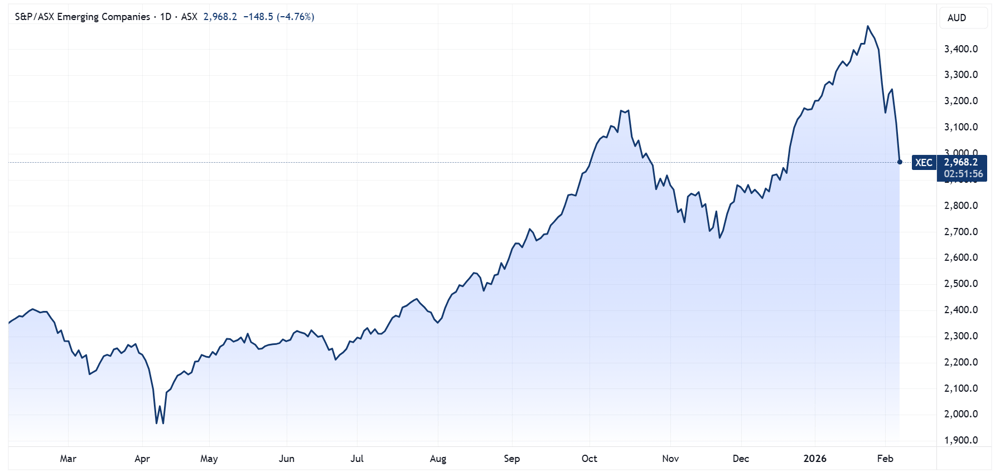
S&P/Emerging Companies Index chart (Source: TradingView)
The S&P/ASX 200 Tech Index dropped another 3.8% to its lowest level since December 2023. It has now fallen 43% since late September and is down 13% over the past three sessions alone.
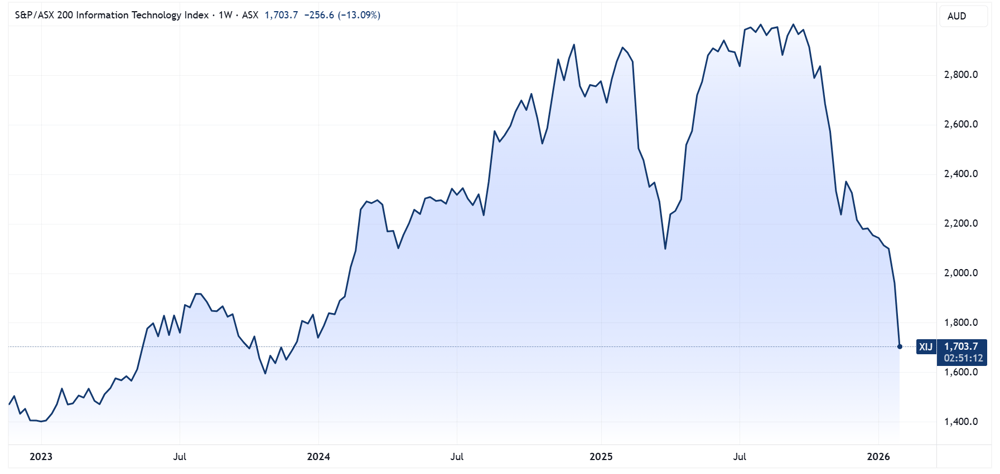
S&P/ASX 200 Tech Index chart (Source: TradingView)
Tech and software stocks have been hit hard in recent days after Anthropic launched several new capabilities, including its agentic Cowork facility and Claude Opus 4.6, sparking concerns about AI disruption to traditional business models.
Commodity volatility continues
To add further insult to injury, commodity prices experienced a sharp pullback overnight.
Commodity | % Chg | Price (US$) |
|---|---|---|
Silver | -19.5% | $70.9/oz |
Platinum | -10.4% | $1,995/oz |
Chinese lithium carbonate futures | -10.0% | 132,800 yuan/t |
Gold | -3.7% | $4,776/oz |
Copper | -3.5% | $5.76/lb |
Brent crude | -2.3% | $67.31/bbl |
Nickel | -1.6% | $16,930/t |
Aluminium | -1.0% | $3,013/t |
Commodity price performance on Thursday, 5 February 2026
While most of these commodities are trading slightly higher on Friday, this was not enough to offset those overnight declines. The resources sector faces broad-based selling:
Coal: Stanmore, Whitehaven and New Hope all down 3-4%
Copper: Sandfire (-1.1%), Capstone Copper (-4.2%), Firefly Metals (-8.3%)
Gold: Most names are down 2-5%
Lithium: PLS Group (-1.0%), Liontown (-1.1%), MinRes (-4.1%), IGO (-5.0%)
Uranium: Most names down 5-10%
Where to from here?
It feels like there's nothing positive out there and that's usually the case when markets begin to roll over.
The RBA delivered a 25 basis point rate hike earlier this week after 75 basis points of easing last year. Economists now expect a follow-up increase in May against a backdrop of elevated inflation and low unemployment. Morgan Stanley expects this policy pivot, combined with tax increases flagged for the Federal Government's May Budget, to drive a sharper economic slowdown.
Wall Street faces its own set of challenges:
December job openings fell to the lowest level since 2020, while global outplacement firm Challenger reported layoffs surging to the highest level since 2009
Software stocks have shed almost $1 trillion in US equity market value amid AI disruption concerns
Federal Reserve Chair nominee Kevin Warsh is viewed as the more hawkish option, having been a longstanding critic of using the balance sheet as a policy tool
Analysts note very crowded positioning, with retail investors not buying the dip
Despite elevated volatility, the ASX is expected to deliver a sharp improvement in earnings after three years of flat to negative growth, according to Morgans. Market earnings are projected to rise 8% in both FY26 and FY27. On Wall Street, approximately 33% of S&P 500 companies had reported by last Friday, posting an earnings growth rate of 11.9% versus the 8.3% expected.
The bottom line
The combination of deteriorating breadth, high volatility and hawkish central banks paint a downbeat picture in the near term. However, with earnings still expanding at a healthy pace, fundamentals may provide support once the current wave of selling exhausts itself. We'll just have to see where the dust settles.