ASX 200 Materials sector notches biggest outperformance since 2009
Resources sector up 44% since July in strongest showing since 2009, but investors remain cautious on durability of the rally.

Source: iStock
KEY POINTS
- The S&P/ASX 200 Materials sector has climbed 44% since early July 2025 compared to 3.6% for the ASX 200, marking the strongest relative outperformance since 2009.
- Morgan Stanley expects the rally to continue based on favourable supply dynamics, robust demand signals, and potential for spot commodity prices to drive earnings upgrades.
- The rotation has been broad-based across gold, copper, iron ore, lithium and uranium rather than concentrated in a single commodity, with many investors still lightly positioned.
The ASX resources sector has delivered its strongest relative performance in 16 years, climbing 44% since July 2025, far outperforming the S&P/ASX 200's 3.6% gain. Despite representing the largest outperformance for the Materials sector since 2009, Morgan Stanley argues the rally still has further to run.
The analysts note that the V-shaped move has caught many investors off guard, with positioning remaining light relative to benchmarks, as fund managers wait for traditional signals like major Chinese stimulus, that have yet to materialise.
What's driving the rally
Morgan Stanley points to several factors driving the resources rotation.
Supply constraints across multiple commodities and still-solid demand
The rally has been notable for its breadth rather than being concentrated in a single commodity
Gold led the initial move, followed by copper, then build commodities like nickel, coal and aluminium
Lithium is also bouncing from mid-2025 lows, iron ore has defined expectations to trade above US$100 a tonne and uranium is also breaking to ~18 month highs
This staggered rotation across different commodities, each with distinct drivers, has led many investors to approach the trend commodity by commodity rather than taking a holistic sector view. Morgan Stanley suggests this fragmented perspective has contributed to positioning remaining behind the rally.
Earnings upside potential
A key driver of Morgan Stanley's conviction is the potential for spot commodity prices to translate into higher average realised prices, which would flow through to company earnings.
The analysts note that momentum factors are now firmly established for the sector, both in terms of price and earnings metrics. Systematic trading strategies that follow momentum should provide additional support to the rally. M&A activity is also picking up in the resources space, providing another mechanism for price discovery and supporting valuations.
Market valuations
The S&P/ASX 200 is currently trading at 18.3x forward earnings, well-above its long-term average of 14.8x. However, consensus estimates point to earnings growth of 8.9% for FY26 and 8.6% for FY27.
Morgan Stanley's analysis of previous periods when the resources sector outperformed the broader market by more than 30 percentage points shows these rotations typically continued for extended periods rather than quickly reversing.
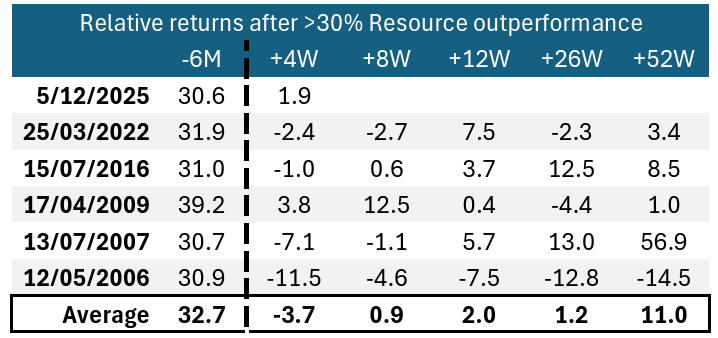
Resource sector returns after >30% outperformance | Source: Morgan Stanley
Despite the aggressive outperformance, the resource rally does not look outsized relative to historical moves.
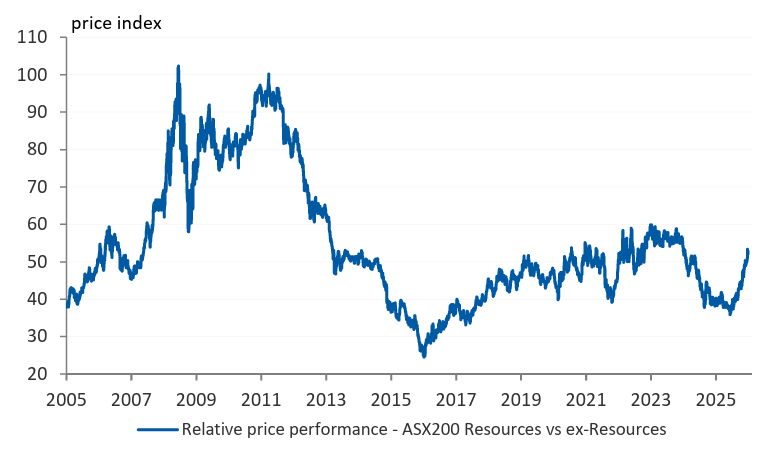
Relative price performance of ASX 200 Resources vs. ex-Resources | Source: Morgan Stanley
Positioning and outlook
The absence of a ‘big bang’ Chinese stimulus package has left many investors on the sidelines, waiting for a clearer signal before increasing exposure. However, Morgan Stanley argues that the incremental nature of commodity-specific catalysts over the past six months should not obscure the strength of the broader trend
The analysts maintain high conviction that the current rotational episode can extend further, supported by favourable supply dynamics, positive demand indicators, and the self-reinforcing nature of momentum.
Morgan Stanley's model portfolio includes major diversified miners BHP and Rio Tinto, along with South32, BlueScope Steel, Iluka Resources, Newmont, and Pilbara Minerals.
For investors, the key question is whether to chase performance that has already delivered substantial gains or wait for a pullback that may not arrive if the structural factors supporting the rotation remain intact.