ASX 200 Live Today - Wednesday, 11th March
The S&P/ASX 200 is set to edge higher as the Iran conflict continues to escalate. Here are today's top stories.

Today’s ASX 200 Updates
Welcome to our live ASX coverage for Wednesday, March 11. Expect a high volume of posts pre-market and more periodic updates throughout the day. We'll be wrapping the blog up around 2:00 pm AEST. Let us know how we can make it even better.
ASX 200 higher, Iran keeps markets on edge
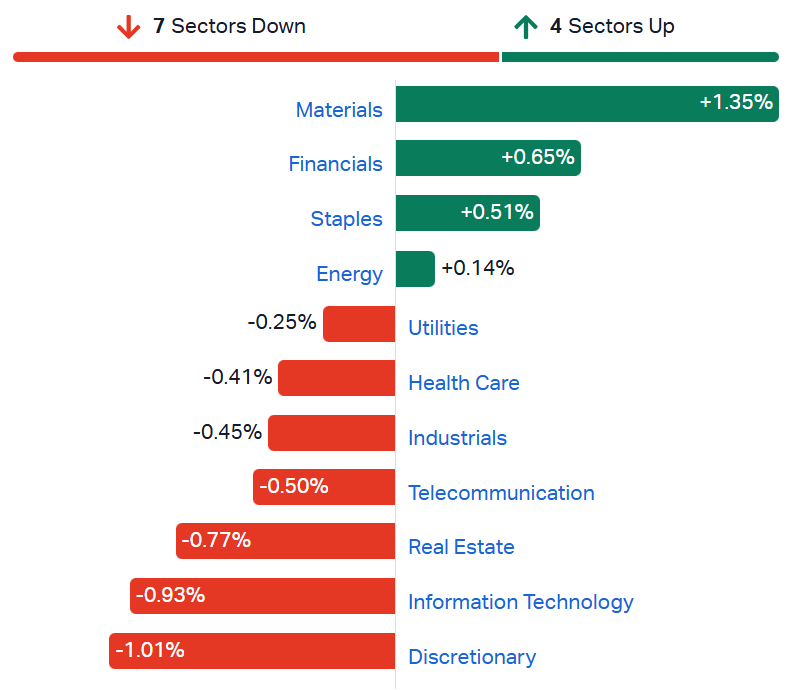
[2:30 pm] Apologies for the late closer. The ASX 200 is trading 0.54% higher, a bit off best levels but now back above the key 200-day moving average. Rather narrow breadth and leadership today, with Banks and Miners driving the bulk of the market's gains, while sectors like Utilities, Healthcare and Tech declined more than 1%.
WTI crude is down 3.1% to US$83 a barrel, as the IEA seriously considers its largest-ever emergency oil reserve release. Meanwhile, the Iran conflict continues to rattle markets and Trump's messaging isn't helping. One moment the war will last four days, the next it's five weeks. Yesterday it was "very much complete" and now, apparently, it's just the beginning. US futures currently positive, with S&P 500 and Nasdaq futures up 0.42% and 0.45% respectively. We'll just have to see whether or not the market can muster up some more strength after that ~6.5% dip over 2-9 March.
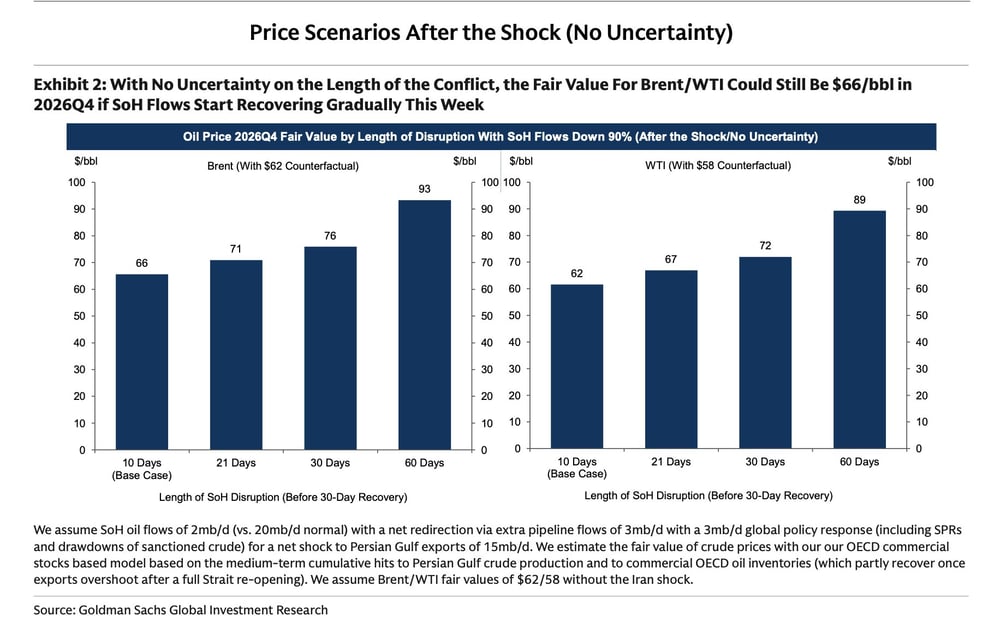
On a side note, food security concerns are mounting, as the Strait of Hormuz handles one-third of the world's seaborne fertiliser. Goldman Sachs also notes that the longer the Strait stays closed, the higher the oil price floor will be once it reopens.
IEA reserve plan cools oil
[1:34 pm] Oil is swinging sharply as traders weigh a potential record IEA stockpile release against ongoing supply disruption through the Strait of Hormuz.
The IEA is proposing a record emergency reserve release that would exceed the 182 million barrels deployed in 2022 after Russia’s invasion of Ukraine, according to the WSJ
The headline capped the latest rally, with Brent giving up gains after rising as much as 3.7%, while WTI fluctuated near $84 a barrel after briefly punching above $100 on Monday.
Saudi Arabia, Iraq, the UAE and Kuwait have lowered collective output by as much as 6.7 million barrels a day, equivalent to about 6% of global supply, while the UAE’s biggest refinery was halted after a drone strike.
Higher crude and gasoline prices are adding to political pressure on Trump, while Saudi Aramco CEO Amin Nasser warned prolonged disruption would have catastrophic consequences for global oil markets and the broader economy.
Source: Bloomberg
Asia braces for fuel shock
[1:24 pm] Asian governments are moving to ration fuel use and protect households as the near closure of the Strait of Hormuz exposes the region’s heavy reliance on imported energy. Policymakers are already rolling out emergency demand curbs.
Thailand has adopted work from home arrangements and suspended non essential overseas travel. The Philippines has shifted government offices to a four day week. Pakistan has cut the working week and India has re-directed LPG supplies from industry to households.
Vietnam is taking a more interventionist approach, cutting import tariffs on some petroleum products and requiring uncommitted oil exports to be sold to domestic refineries. Its aviation authority also warned jet fuel shortages could emerge from early April.
Vietnam’s aviation authority said Vietnam Airlines’ monthly operating costs could rise 50-60%. Aviation adviser Linus Benjamin Bauer said Asian carriers are more exposed than Western peers because many hedge fuel less aggressively, meaning higher fuel costs flow through to earnings faster.
Source: Bloomberg
Trump off-ramp talk steadies markets
[1:06 pm] Trump’s latest remarks that the war could end soon were seen by some investors as a potential off-ramp. Especially, as surging oil prices and weak public support risk becoming a political problem ahead of the US midterms.
Any sign of a shorter conflict could help cap upside in crude and ease worst-case Strait of Hormuz disruption fears. Iran has responded defiantly, saying it will determine when the war ends and reiterated threats to Gulf oil flows.
Source: SCMP
Energy stocks continue to drag
[12:10 pm] Energy stocks are down 1-4% as WTI crude oil falls 3% to about US$83 a barrel.
Ticker | Company | % Chg | Price |
|---|---|---|---|
AGL | Agl Energy | -4.40% | $9.13 |
BPT | Beach Energy | -1.61% | $1.10 |
ORG | Origin Energy | -0.93% | $11.68 |
WDS | Woodside Energy Group | -0.40% | $30.06 |
STO | Santos | -0.20% | $7.36 |
By Warren Masilamony
Lithium stocks higher
[11:57 am] Benchmark lithium carbonate futures have risen for a third consecutive day, up 4.1%, lifting lithium stocks 1-4%.
Ticker | Company | % Chg | Price |
|---|---|---|---|
MIN | Mineral Resources | 4.00% | $59.75 |
PLS | Pls Group | 2.25% | $4.78 |
LTR | Liontown | 1.71% | $1.61 |
IGO | Igo | 0.85% | $7.75 |
VUL | Vulcan Energy Resources | 0.72% | $3.52 |
By Warren Masilamony
Tech stocks lower
[10:58 am] ASX 200 Tech Index down 2.2%, with recent bounce-back winners like Life360, Siteminder and Wisetech leading the decline. The Index is now up 8.8% from its 24-Feb low compared ~14.7% just four days ago.
Ticker | Company | % Chg | Price |
|---|---|---|---|
360 | Life360 | -6.13% | $21.13 |
SDR | Siteminder | -4.56% | $3.35 |
WTC | Wisetech Global | -4.44% | $48.81 |
DGT | Digico Infrastructure Reit | -3.49% | $1.80 |
CAT | Catapult Sports | -3.33% | $3.77 |
AD8 | Audinate Group | -2.78% | $2.80 |
XRO | Xero | -2.71% | $81.45 |
HSN | Hansen Technologies | -2.07% | $5.21 |
TNE | Technology One | -2.04% | $26.88 |
PME | Pro Medicus | -2.00% | $136.89 |
MP1 | Megaport | -0.75% | $7.95 |
BVS | Bravura Solutions | -0.71% | $2.10 |
OCL | Objective Corporation | -0.66% | $13.65 |
WBT | Weebit Nano | -0.42% | $4.70 |
DTL | Data#3 | -0.40% | $7.40 |
NXL | Nuix | 0.39% | $1.81 |
IRE | Iress | 0.54% | $7.50 |
NXT | NextDC | 0.82% | $12.86 |
MAQ | Macquarie Technology Group | 0.86% | $63.29 |
CDA | Codan | 0.88% | $35.64 |
DDR | Dicker Data | 1.34% | $9.08 |
RBA hawks circle as inflation expectations spike to 14-year high
[10:44 am] ANZ-Roy Morgan weekly inflation expectations surged 0.8 percentage points to 6.1%, the largest single-week rise since the survey's 2010 inception.
Governor Bullock has explicitly flagged inflation expectations as a key variable the Board is monitoring, making the timing particularly uncomfortable
Deputy Governor Hauser struck a hawkish tone overnight, describing oil price volatility as a "genuine challenge" and warning that persistent energy price rises could worsen the inflation outlook in an economy already running above capacity
Hauser said the policy response hinges on the size and persistence of the shock, both of which remain uncertain, but he left the door open to tighter policy if energy price effects become embedded
The market is now pricing in a ~65% likelihood of a 25 bp hike at next week's RBA meeting.
How Australian sectors performed after Russia invaded Ukraine
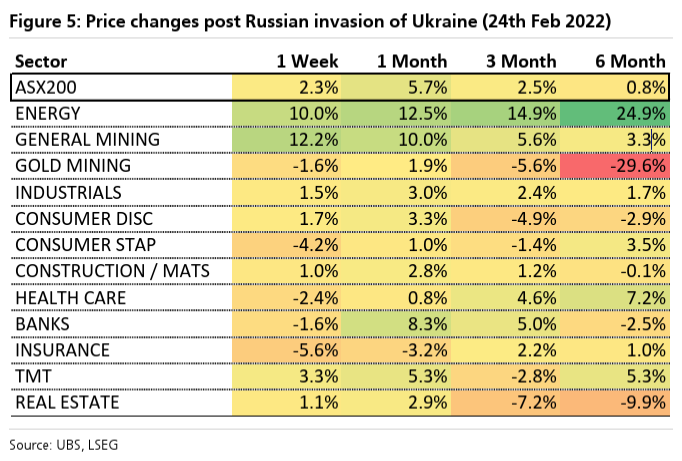
[10:39 am] An interesting table from UBS which outlines how ASX 200 sectors performed after Russia invaded Ukraine (24-Feb-2022).
Source: UBS
A few interesting observations:
Energy experienced a big spike in the first week, but traded relatively sideways for the next couple of months. Six months later, oil prices were trading around pre-invasion levels, yet that's when energy stocks re-rated higher
Gold was smashed, likely representing elevated demand for energy commodities. Higher input costs also weighed on miner margins.
Yields surged post-invasion (e.g. Aussie 10-year up from ~2.1% in Feb-22 to over 4% by Jun-22), weighing on yield sensitive sectors like real estate
Top ASX 200 gainers
[10:15 am] Lynas is trading sharply higher off the back of a major long-term supply agreement with Japan, which has also lifted peers like Iluka. Gold stocks also broadly higher after bullion prices ticked 0.99% higher overnight to US$5,190 an ounce.
Ticker | Company | % Chg | Price |
|---|---|---|---|
LYC | Lynas Rare Earths | 12.95% | $20.02 |
OBM | Ora Banda Mining | 12.88% | $1.32 |
ILU | Iluka Resources | 9.36% | $6.66 |
4DX | 4DMedical | 4.06% | $4.61 |
PNR | Pantoro Gold | 3.96% | $3.94 |
IPX | Iperionx | 3.53% | $7.03 |
NXG | Nexgen Energy | 3.18% | $18.17 |
ALK | Alkane Resources | 3.01% | $1.61 |
NST | Northern Star Resources | 2.66% | $26.65 |
BGL | Bellevue Gold | 2.65% | $1.75 |
Top ASX 200 losers
[10:15 am] Software stocks are taking a breather after a sharp rally from multi-year lows. The iShares Tech-Software ETF eased 2.3% overnight, marking the first major pullback since its ~14% rally over the past two weeks.
Ticker | Company | % Chg | Price |
|---|---|---|---|
360 | Life360 | -6.71% | $21.00 |
RYM | Ryman Healthcare | -6.15% | $1.83 |
BXB | Brambles | -3.24% | $22.43 |
GQG | GQG Partners | -2.88% | $1.86 |
ASB | Austal | -2.43% | $5.03 |
WTC | Wisetech Global | -2.32% | $49.90 |
BRG | Breville Group | -2.29% | $28.60 |
RMD | Resmed | -2.02% | $34.70 |
JHX | James Hardie | -2.01% | $29.32 |
CAR | Car Group | -1.84% | $25.55 |
ASX 200 higher, Banks and Miners lead
[10:08 am] ASX 200 higher for a second day, now pushing above the 200-day moving average. Currently up 0.39% in a resources and bank led session. To be fair, miners have been battered the most in recent days, with the Materials Index down 14.6% between 3-9 March. A relatively broad Materials bounce, spanning the majors, lithium, gold, rare earths, copper and more.
ASX 200 sectors (Source: Market Index)
Lynas and rare earth stocks open broadly higher
[10:00 am] Lynas has opened 11.5% higher to $19.71, within an arms reach of recent highs ($20) and now 10% from its 14-Oct-25 record high. Rare earth stocks have opened broadly higher, including Iluka (+7.2%), Lindian Resources (+5.8%), Northern Minerals (+4.0%) and Arafura Rare Earths (+4.0%).
UBS says Lynas deal future-proofs earnings
[9:33 am] UBS says the updated JARE agreement minimises commodity price risk for Lynas and, combined with the renewed Malaysia LAMP licence, marks a strategic pivot toward margin expansion via magnets and heavy rare earths.
The $110/kg NdPr floor is the key takeaway for investors
UBS notes running $110/kg through its model increases FY26/27/28 earnings by at least 25%, implying further upside to its current long-term NdPr price assumption of US$100/kg
UBS maintains a Buy rating but makes no model or price target changes pending additional work on Lynas' 2030 strategy
The new terms make it increasingly unlikely future western rare earth supply agreements will be struck materially below $110/kg, effectively anchoring a market floor
The 75% HRE volume commitment is seen as a catalyst for other ex-China consumers who have yet to secure supply to accelerate procurement plans
Company page: Lynas Rare Earths (LYC)
Lynas secures major long-term price agreement
[9:31 am] Lynas has renewed its offtake agreement with Japan Australia Rare Earths (JARE) through 2038, securing a firm commitment for 5,000 tonnes of NdPr per annum at a market-linked floor price of US$110/kg.
JARE has a firm commitment to purchase 5,000 tonnes NdPr per annum, with availability of up to 7,200 tonnes subject to no opportunity loss to Lynas.
Pricing is market-linked with a US$110/kg floor
Upside sharing kicks in above US$150/kg NdPr, with 30% of the excess payable to JARE, capped at US$10m per calendar year, limiting Lynas' revenue dilution in a price rally
Heavy rare earth (HRE) oxides are also covered: 75% of all HRE production made available to Japanese industry, with JARE committing to purchase 50% of total HRE output at no opportunity loss to Lynas
CEO Amanda Lacaze flagged the deal reduces price volatility for Lynas and underpins continued investment in operations, with the price floor providing a revenue baseline against soft spot market conditions
Company page: Lynas Rare Earths (LYC)
Rio Tinto locks in $1.1bn for Rincon lithium project
[9:24 am] Rio Tinto has secured a $1.175bn financing package from four multilateral and export credit lenders to advance its $2.5bn Rincon lithium project in Argentina.
Funding provided by IFC, IDB Invest, Export Finance Australia and JBIC, diversifying project financing beyond Rio's own balance sheet
Rincon targets ~60,000 tpa of battery-grade lithium carbonate at full capacity, with first production expected in 2028 and a three-year ramp to nameplate
Project carries a 40-year mine life, underscoring the long-duration nature of the capital commitment relative to near-term lithium price volatility
At $2.5bn total project cost, the financing package covers ~47% of capex, with construction already underway including camp expansion and site infrastructure
Company page: Rio Tinto (RIO)
Why commodity stocks don't track spot prices
[9:23 am] There's probably some frustration and confusion out there as to why energy equities aren't rally as much despite surging oil prices. Here's some food for thought:
Spot vs. futures curve: Equity valuations reflect discounted future cash flows across all future production, not today's spot price. Deep backwardation means only a fraction of output is realised at elevated spot levels
Hedging is costly and risky: Forward-selling production requires posting exchange margin, and producers have been wiped out historically when markets move against hedges and collateral calls escalate
Uncertain production: Variable yields, operating conditions and financing constraints mean future output is inherently unpredictable, creating reflexivity that prevents full hedging even when economics might suggest it
Equity risk premium: Commodity stocks are still equities and reprice with broader market moves. Many are also leveraged, making earnings sensitive to borrowing costs that can spike in volatile environments
Business mix : For example, Indian refiners import crude and sell into capped domestic markets, meaning they trade with a negative correlation to oil prices. Western producers face the same logic in reverse, with supply disruptions helping some and hurting others depending on their exposure
Energy stocks also performed quite well in 2025, relative to oil prices. Last year, the S&P/ASX 200 Energy Index slipped ~4%, while crude dipped around 20%.
Strait of Hormuz remains shut
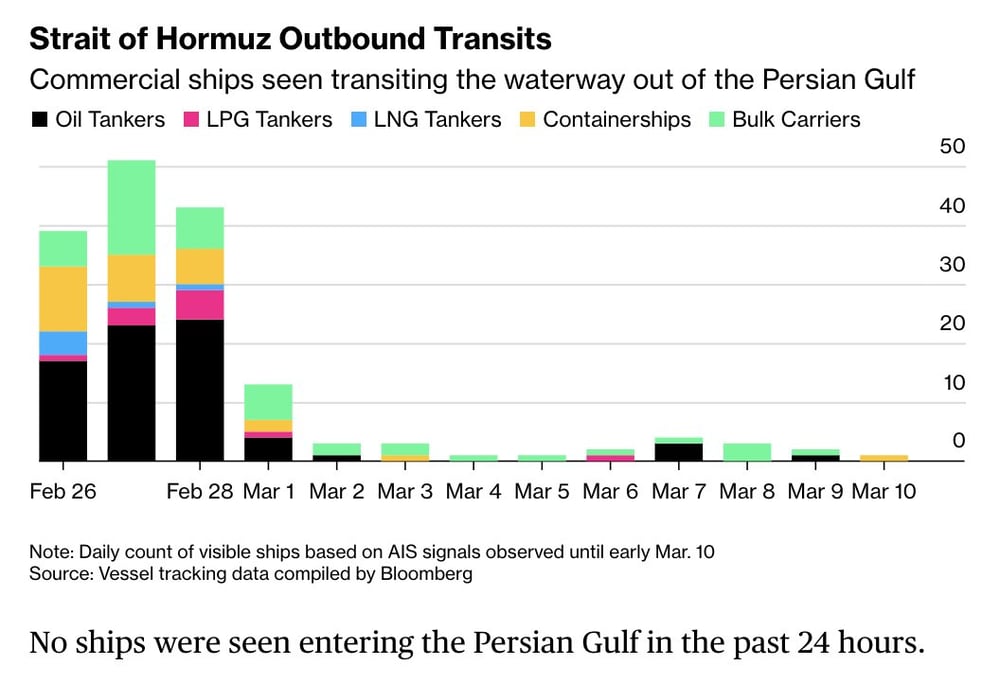
[9:15 am] Vessel tracking data compiled by Bloomberg shows near-zero oil flow through the Strait of Hormuz, though some ships may have disabled their transponders.
Source: Bloomberg
Oil's brief dip
[9:12 am] US Energy Secretary Chris Wright said the US navy successfully escorted an oil tanker through the Strait of Hormuz to support energy flows to global markets.
This drove WTI crude down as much as 9.8% overnight to US$76.73.
A few moments later, he deleted the post and WTI quickly reversed back towards breakeven.
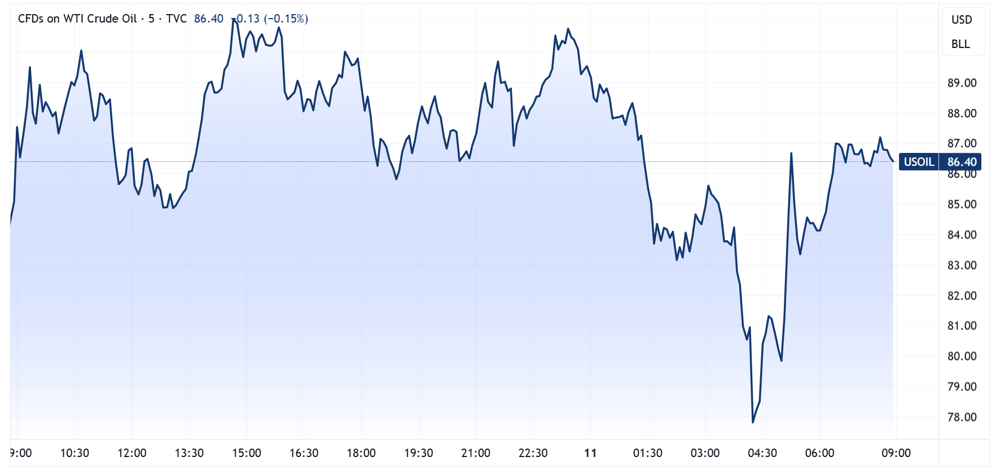
WTI intraday chart (Source: TradingView)
Trump warns Iran over Hormuz mines as US strikes mine vessels
[9:04 am] The US military destroyed 10 inactive Iranian mine-laying vessels on Tuesday as Trump issued a stark warning over any attempts to mine the Strait of Hormuz.
US intelligence flagged that Iran was preparing to deploy naval mines via small vessels carrying 2-3 mines each
Trump warned Iran that failure to remove any mines placed in the strait would result in military consequences "at a level never seen before," while the Pentagon confirmed strikes on mine-laying vessels and storage facilities
The US military is exploring options to escort ships through the strait, though the White House confirmed no tankers have been escorted yet, correcting an erroneously captioned post by Energy Secretary Chris Wright
Iran's Revolutionary Guards denied any escort had occurred, warning that "any movement of the US fleet and its allies will be stopped by our missiles and drones"
Source: Reuters
Gulf producers cut output by a third as Hormuz closure deepens
[9:03 am] Saudi Arabia, the UAE, Iraq and Kuwait have collectively slashed production by up to 6.7 million barrels per day, representing around a third of their combined output, as the effective closure of the Strait of Hormuz enters its 11th day.
Iraq has absorbed the deepest proportional cut at ~60% of February output, while Saudi Arabia, UAE and Kuwait have each curtailed by 20-25%, with Saudi shipments being rerouted through the Red Sea at record volumes
Global inventories were already at five-year lows heading into the disruption
Aramco CEO Amin Nasser warned spare capacity is overwhelmingly concentrated in the affected region, making a swift resumption of Hormuz shipping "absolutely critical"
The US has responded by allowing India to purchase sanctioned Russian oil to free up supply, and launched a $20bn reinsurance programme for vessels transiting Hormuz
Source: Bloomberg
US pump prices hit 18-month high as Hormuz disruption bites
[8:58 am] Average US unleaded petrol prices have surged 21% in a month to $3.54 per gallon, the highest since mid-2024.
The Strait of Hormuz disruption drove the biggest three-day jump in US gas prices since Hurricane Katrina in 2005, with crude whipsawing before settling around $84/bbl after briefly breaching $100
Saudi Aramco CEO Amin Nasser warned the conflict could have "catastrophic consequences" for global oil markets, calling it the biggest crisis the region's energy industry has ever faced
Prices remain well below the 2022 post-Ukraine invasion peak, though the trajectory creates a direct political problem for Trump, who campaigned on cost-of-living relief and cited falling energy prices as proof inflation had been defeated
Seasonal factors will add further upward pressure independent of the conflict, with the more expensive summer-blend fuel set to enter the market later in spring
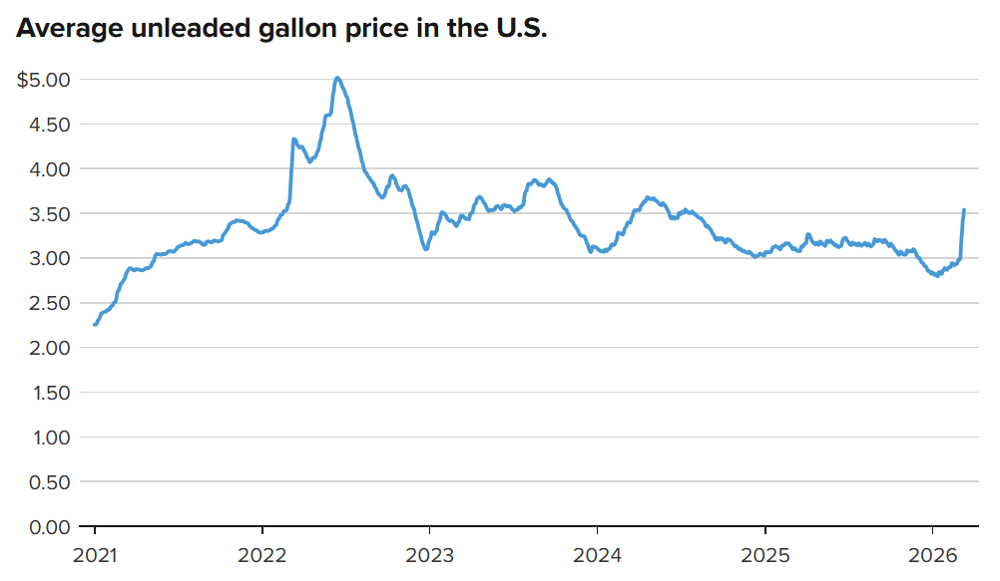
Source: CNBC, AAA
US insiders dump shares at fastest rate in 20 months
[8:56 am] Reuters notes that the seller-to-buyer ratio among US corporate executives hit 4.2 in February, the highest in 20 months, as market volatility and AI disruption fears drove a sharp pullback in insider buying.
Sell-to-buy ratio of 4.2x was the widest since July 2024, with 2,260 sell transactions versus just 543 buys across US public companies
Total shares sold reached ~$6.6bn in February, with S&P 500 executives alone accounting for $4.9bn in sales against only $271m in purchases (an 18:1 ratio by dollar value)
The data predates the Iran conflict, meaning the sentiment captured reflects AI disruption fears and tariff concerns only, suggesting the current read could be even more cautious
Analysts note insider transactions are often personal financial decisions rather than market calls, but the scale of the divergence is being flagged as a signal of broader corporate caution
Source: Reuters
China trade surges ahead of Iran war fallout
[8:52 am] China posted record-high trade figures for January-February, though the escalating US-Israel strikes on Iran now cloud the outlook.
Exports surged 22% year-on-year, well above the 7.2% Bloomberg consensus estimate, with imports up nearly 20% and the trade surplus hitting an all-time high of $214bn for the period
Mechanical and electrical products led the way, with integrated circuit exports up 73% and car exports up 67%, reflecting AI supply chain demand (Societe Generale)
The US was the only major region to record a decline in Chinese exports, down 11%, while shipments to ASEAN rose 29% and the EU nearly 28%
Source: Bloomberg
Apple's India pivot picks up pace
[8:51 am] Apple assembled 55 million iPhones in India in 2025, a 53% jump, as the company races to reduce its reliance on China amid ongoing tariff pressures.
Output up 53% year-on-year to ~55 million units, representing roughly a quarter of Apple's total global iPhone production of ~220-230 million units
The shift is driven by US tariffs on Chinese goods, with India emerging as the primary alternative manufacturing hub alongside Vietnam
All iPhone 17 models, including Pro and Pro Max, are now assembled in India via suppliers Foxconn, Tata Electronics and Pegatron
Cost disadvantages remain relative to China and Vietnam, prompting Apple and Samsung to lobby New Delhi for a fresh round of subsidies ahead of the current scheme's expiry on 31 March
Source: Bloomberg
US stocks give back early gains
[8:49 am] US indices opened in positive territory but struggled to hold onto gains, closing mostly lower and near worst levels. S&P 500 (-0.21%) outperformed its equal-weight counterpart (-0.75%) as tech stocks finished marginally higher while sectors like Energy (-1.32%), Healthcare (-0.73%) and Utilities (-0.65%) underperformed. There appears to be no meaningful off ramp with the Iran conflict, despite Trump's remarks on Tuesday about the war being "very complete" and ahead of schedule.
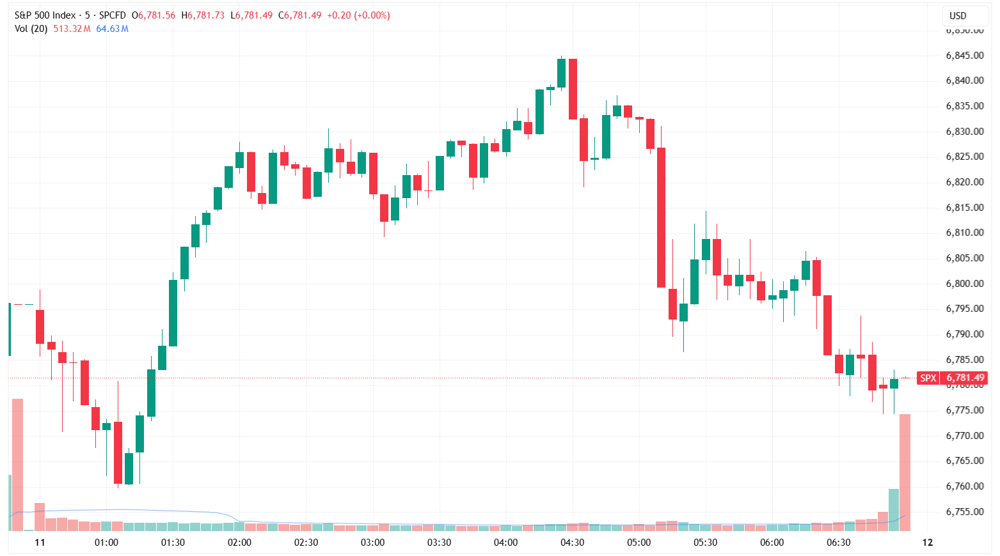
S&P 500 intraday chart (Source: TradingView)
Good morning!
[8:30 am] ASX 200 futures are up 24 pts (+0.27%) as of 8:30 am AEDT.
The overnight session in a nutshell:
Major US benchmarks finished mostly lower, gave back early gains to close around session lows
S&P 500 faded a 0.72% gain in early trade as latest Iran updates suggest no de-escalation, limited Strait of Hormuz activity and continued energy production cuts from Gulf oil giants
WTI crude dipped as much as ~9% after US Energy Chief Wright posted that the navy escorted a vessel through the Strait, he then immediately deleted the post, sending oil prices back towards breakeven