ASX 200 heads for worst day since March as rate hike fears return
The ASX 200 has erased Wednesday's relief rally and then some, as markets realise yields, oil and rate expectations haven't budged.

.jpg)
Source: Shutterstock
KEY POINTS
- The ASX 200 is on track for its worst session since March, falling almost 2% to its lowest level since 10 June and back into negative territory year-to-date.
- Wednesday's rally was driven by a slightly cooler-than-expected CPI print and RBA commentary read as dovish, but bond yields, oil and rate expectations haven't materially changed.
- Breadth is abysmal, with around 90% of ASX 200 stocks lower and every sector in the red. Energy (-3.1%) and Real Estate(-2.2%) are leading the losses.
Just a day after a 0.9% relief rally, the ASX 200 is on track for its worst session since March, down 152 points or 1.73% at the time of writing.
Wednesday's bounce came off the back of largely in-line inflation data and hopes that the RBA may be done hiking, and that bond yields have finally peaked after an unprecedented run to multi-decade highs. That relief proved short-lived, with the index now trading at its lowest since 10 June and back in negative territory year-to-date.
Below, we unpack why the market seemed so strong on Wednesday and what's driving today's carnage.
Tuesday's reversal, Wednesday's rally
The ASX 200 was in a technically vulnerable spot heading into Tuesday's RBA hike and Wednesday's inflation data. It was down 6.5% from its 6 August record high and slightly negative year-to-date.
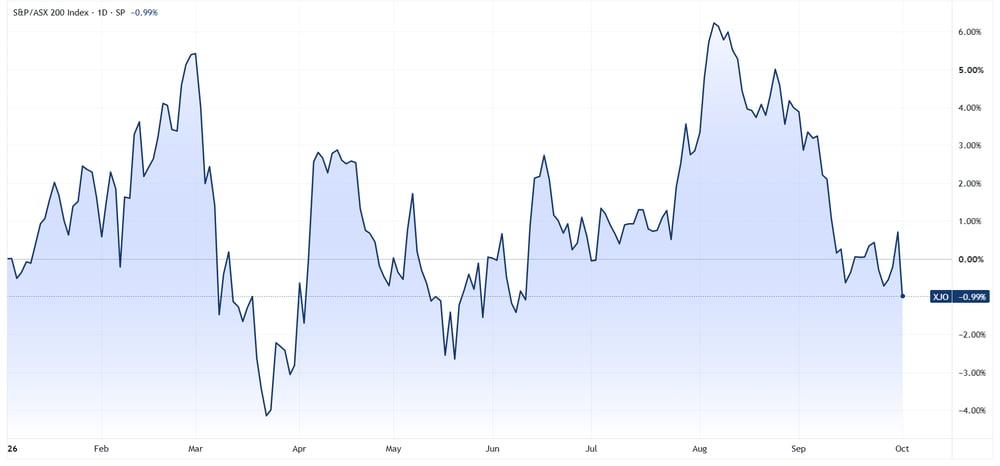
S&P/ASX 200 year-to-date (Source: Market Index)
The market didn't move a whole lot when the RBA hiked at 2:30 pm AEST on Tuesday. But Governor Bullock's comments at the press conference might've been the catalyst for a sharp rally in the last 30 minutes of trade, with the index swinging from a 0.2% decline to a 0.34% gain by the close. Bullock told reporters "the hope here is that this will be restrictive enough... to bring things down." Markets clearly saw the word "hope" as a signal that the RBA is desperate to pause its aggressive tightening cycle.
Wednesday then delivered another immaterial but 'hopeful' piece of data. August inflation was still well above the RBA's 2-3% target, but largely in line with market expectations.
Headline CPI up 0.4% month-on-month vs. 0.5% ests, from 1.0% in July
Headline CPI up 4.0% year-on-year, vs. 4.1% ests from 3.5% in July
Trimmed mean up 3.6% year-on-year vs 3.6% ests, unchanged for a third straight month
Trimmed mean up 0.2% month-on-month vs 0.3% ests, from 0.5% in July
The ASX 200 was trading around 0.2% higher before the CPI release at 11:30 am AEST and was up almost 1% by noon. Rate-sensitive sectors caught an aggressive bid, with Real Estate soaring 3.6%, Discretionary up 2.2% and Telcos up 1.9%.
The data also sent the rate-sensitive 3-year yield down as much as 7 bps to 4.87%, though it finished the session fractionally higher at 4.95%.
Nothing's changed
So that takes us to Thursday. We've had a bit of a relief rally off the back of a widely expected RBA hike, some 'hopeful' commentary and a slightly cooler-than-expected CPI print.
Wall Street saw a similar reversal overnight. The policy-sensitive US 2-year yield fell as much as 5 bps to 4.82% but finished fractionally higher at 4.87%. Meanwhile, the long end of the curve (10- and 30-year yields) kept grinding higher to fresh multi-decade highs.
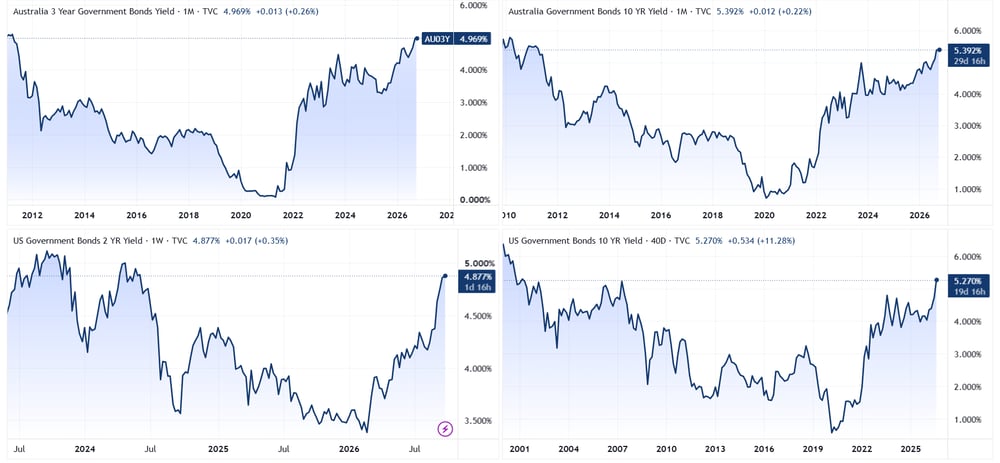
Australia 3-year (top left) and 10-year (top right) yields, US 2-year (bottom left) and 10-year (bottom right) yields | Source: TradingView
Today has been the inverse of Wednesday. Every sector is in the red, with Energy (-3.0%), Real Estate (-2.2%), Healthcare (-2.2%) and Financials (-2.0%) leading the decline. Breadth is abysmal, with approximately 180 ASX 200 constituents (90%) trading lower.
It's a bit of a realisation that there are still more rate hikes on the table. That comes at a time when Australia has the second-highest interest rate in the developed world, one of the highest core inflation rates among major developed economies and one of the highest 10-year bond yields.
More proof is needed
The bottom line is that the relief rally came when plenty of hawkishness was already priced in, and after the market had copped a sharp 6.5% tumble in the weeks heading into the catalyst. But bond yields, oil prices and rate expectations haven't really changed, and there's been little evidence that the Australian 10-year yield is making any progress towards peaking or normalising back towards 5.0%. The market is clearly eager to rally on any "hope" that these key inputs are moving in the right direction. For now, though, breadth remains poor, with no leading sectors and no sustained follow-through on those bounces.