ASX 200 gold miners’ costs jump in the September quarter, but NEM, NST and EVN beat UBS forecasts
Shutdowns, wet weather and dearer fuel pushed gold miners’ costs higher last quarter. Will this continue through the year into 2027?


Source: iStock
Mentioned
KEY POINTS
- Gold miners have spent years banking strong prices, building cash and buying rivals, even as inflation, fuel and royalties kept pushing costs higher.
- September quarter results show planned shutdowns, wet weather and higher fuel prices pushed costs up, but most miners still came in under what the experts expected.
- See how each miner stacked up against UBS, and whether rising cost pressures are set to ease or keep building.
ASX-listed gold miners have spent the past few years riding a long rally in the gold price, building large cash balances, funding new mines and expansions, and merging with rivals to gain scale. Gold prices have eased since peaking earlier this year, while inflation, fuel and gold-price-linked royalties have kept pushing up the cost of production.
Quarterly reports are a great barometer for investors, showing how much gold a miner produced, what it cost and whether it remains on track for full-year guidance. October is the month for September quarterlies. Most of the major gold producers have reported, and it looks as though the spike in fuel prices that started in March are finally beginning to show up in their cost lines. Management commentary suggests there's significant uncertainty on whether this pressure will ease or build from here.
This article breaks down what drove each miner’s result, which miners expect costs to ease as production recovers, and what could keep pushing them higher.
How the results stacked up
Leading investment bank UBS has one of the most extensive coverages of ASX gold producers. In a recent note, they forecast key production and financial metrics across the sector. I've selected six of the top producers to see how their actual results stacked up against UBS's numbers.
Company | UBSe production (koz) | Production (koz) | Beat/Miss | UBSe AISC ($/oz) | AISC ($/oz) | Beat/Miss |
|---|---|---|---|---|---|---|
Newmont | 1,222 | 1,215.3 | In line (-0.5%) | US$2,032 | US$1,963 | Beat (-3.4%) |
Northern Star | 354 | 354.2 | In line (0.0%) | 3,444 | 3,217 | Beat (-6.6%) |
Evolution | 160 | 153.6 | Miss (-4.0%) | 1,941 | 1,653 | Beat (-14.8%) |
Genesis | 64 | 72.1 | Beat (+12.7%) | 2,983 | 2,966 | In line (-0.6%) |
Ramelius | 49 | 48.8 | In line (-0.3%) | 2,408 | 2,656 | Miss (+10.3%) |
Greatland | 70 | 70.1 | In line (+0.2%) | 2,969 | 2,925 | Beat (-1.5%) |
Source: UBS, company reports. Results within 1% of UBS’s estimate are counted as in line. Newmont figures are in US dollars and on the consolidated, co-product basis UBS uses.
Newmont (NEM): Beat on costs and improved its full-year cost guidance, crediting cost discipline and higher prices for its copper, silver, lead and zinc. It generated US$1.9 billion in free cash flow while management reaffirmed its 2026 production guidance. Shares fell 4.9% the day it released its results on 23 October amid a broader resources sell-off, landing between the 5.5% fall in the S&P/ASX All Ordinaries Gold index (XGD) and the 3.8% fall in the S&P/ASX 200 Materials index (XMJ).
Northern Star (NST): Beat on costs even though its AISC rose 21% from the June quarter, as planned shutdowns and the commissioning of its expanded Kalgoorlie mill cut the gold it sold. FY27 guidance of 1.5 to 1.65 million ounces was unchanged, with production weighted to the second half as the new mill ramps up. Shares rose 1.7% on 21 October, against a 0.7% fall in the XGD, as new chief executive Suresh Vadnagra said all sites were “delivering in line with plan”.
Evolution (EVN): Missed on production after rain at Cowal and power outages at Mungari and Red Lake, but posted the biggest cost beat as record copper prices lifted its by-product credits. Management kept FY27 guidance unchanged and lifted its net cash position to $141 million. Shares fell 3.2% on 14 October, a steeper fall than the XGD’s 1.9%, after a quarter chief executive Lawrie Conway described as “a slower start than expected”.
Genesis (GMD): The only production beat, with costs in line, as it prepares to complete its merger with Vault in late November. Cash rose $78 million to $598 million, and it paid its first dividend in October. Shares fell 3.1% on 22 October, a steeper fall than the XGD’s 1.9%, despite executive chair Raleigh Finlayson calling it “a solid quarter”.
Ramelius (RMS): Missed on costs after rain interrupted ore haulage from its Penny mine, leaving about 4,200 ounces in stockpiles it expects to process this quarter. Management expects costs to fall each quarter as higher-grade ore comes through, and cash and gold rose to $768 million. Shares rose 1.5% on 26 October, lagging the XGD’s 2.9% gain, as managing director Mark Zeptner said the company remains “on track for FY27 production and cost guidance”.
Greatland (GGP): Beat on costs, with management crediting strong processing throughput, and started construction at its Havieron project. It finished the quarter debt-free with $1.31 billion in cash. Shares rose 7% on 26 October, well ahead of the XGD’s 2.9% gain, after managing director Shaun Day said gold production and AISC were both “performing better than planned”.
Will costs keep rising?
AISC is a cost per ounce, so it rises when miners spend more, produce less, or both, and the September quarter brought a mix of the two. Newmont, Northern Star and Greatland carried out planned maintenance shutdowns that added to spending while cutting output, wet weather held up ore haulage at Ramelius and limited access to higher-grade ore at Evolution’s Cowal mine, and several miners processed lower-grade ore. Sustaining capital — the money needed to keep existing mines running — also rose at Newmont, Northern Star and Genesis, while Newmont pointed to higher diesel prices.
Several of the miners expect the pressure to ease as production recovers. Ramelius said its AISC was higher than in the June quarter “but in line with expectations”, and that higher-grade ore from Dalgaranga and Cue will deliver “a reducing AISC profile” through FY27. Genesis expects its second-half AISC “to be less than first half”, Northern Star said AISC “is expected to improve through FY27”, and Evolution chief executive Lawrie Conway said the company has “a production profile that is set to grow in the quarters ahead”.
Newmont expects the opposite, saying its unit costs will rise in the December quarter because of higher sustaining capital spending and lower output of its other metals. It also expects unit costs to rise again in 2027, citing inflation above its 3% assumption, higher diesel prices, unfavourable moves in the Australian dollar and royalties tied to the gold price.
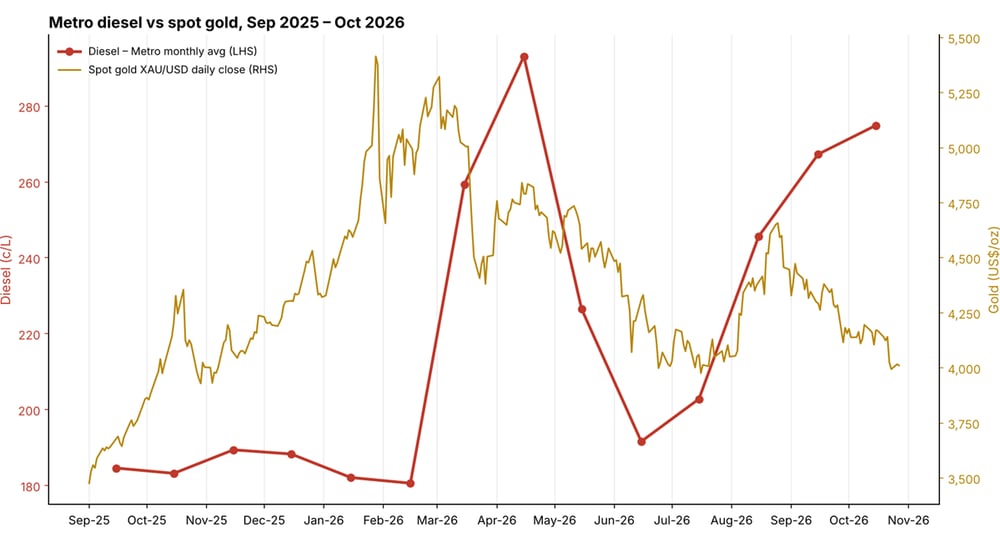
Spot gold and average diesel price (Perth Metro region). Source: TradingView, FuelWatch
Diesel is the cost several miners are watching with Genesis noting the current price of about $1.76 a litre is above the $1.60 built into its guidance. Ramelius has some protection, having locked in 7.2 million litres of diesel at an average of 94 cents a litre out to June 2027, against the $1.34 it paid on average in the September quarter.
Conclusion
The September quarter showed that a rising cost environment doesn’t hit every gold miner the same way, because each one mines, processes and sells its gold differently. AISC ranged from $1,653 an ounce at Evolution to $3,217 at Northern Star, and the biggest swings reflect how differently their operations are set up.
Evolution mines copper alongside its gold, and because copper revenue is deducted from its costs, record copper prices pulled its AISC down even as rain and power outages cut its gold output. Northern Star switched its largest operation, KCGM at Kalgoorlie, over to an expanded mill late in the quarter, and commissioning reduced the gold it recovered, spreading its costs across fewer ounces. Ramelius feeds its central Mt Magnet mill with ore trucked in from outlying mines, so when rain held up haulage from Penny, the ore sat at the mine instead of in the mill.
Much of what moved costs this quarter sat outside the miners’ control, from rain that held up mines and haulage to diesel prices that Genesis linked to the ongoing conflict in the Middle East. A strong gold price is only one part of the profitability equation, which is why quarterly reports, with their detail on costs and operations, are worth reading closely.