ASX 200 braces for confession season as profit downgrades roll in ahead of reporting season
Confession season has arrived early and brutal this year. The warnings from retailers and Judo point to a weakening economy.

Source: Shutterstock
Mentioned
KEY POINTS
- Confession season has come early this year. The US-Iran conflict, sticky inflation and three RBA rate hikes have pushed most sectors outside mining and energy into downgrade mode.
- The latest casualties are Baby Bunting, Worley and Judo. Judo was the standout, crashing 45% on a shock FY26 and FY27 earnings downgrade.
- Earnings expectations are finally falling, clearing the way to beat a lower bar. The question now is whether this is the worst of it, or another leg down looms.
Confession season is the stretch of weeks before official reporting season when companies that know they'll miss expectations get the bad news out early, rather than blindside the market on results day.
It's fair to say that the season kicked off much earlier this year, as the US-Iran conflict, re-acceleration in inflation, three consecutive RBA rate hikes and abysmal consumer confidence forced many companies to update the market and/or temper their prior expectations.
The most notable set of updates came from retail and consumer-facing companies in early May, which noted:
Accent Group (4-May): "Trading to the end of March was in line with its prior guidance and expectations. However, following the escalation in geopolitical tensions in late March ... both sales and gross margin were adversely impacted during April. As a result of the changes in macroeconomic conditions, and the Company’s expectation that these conditions are unlikely to abate in the short term.”
Endeavour Group (4-May): “Following a strong start to Q3 trading, sales momentum in Hotels began to soften in March. Sales growth moderated across all drivers – food, bar, gaming, and accommodation.”
JB Hi-Fi (6-May): “We are seeing significant supplier component related cost increases and stock availability shortages, along with heightened competitive activity.”
Super Retail Group (11-May): “After a strong start to the year, trading conditions in the Auto category moderated through March and April. The impact was most evident in discretionary categories such as power tools, partially offset by increased demand in fuel related and DIY categories including maintenance, braking and trailer components.”
Flight Centre (26-May): “Current turmoil having a more significant impact on leisure results to date. Global corporate business has not significantly affected so far.”
This late March inflection point has now materialised into earnings downgrades, with UBS noting that all sectors outside of mining and energy are now in "downgrade mode", with more to come over the next few months.
The latest batch
There's been plenty of new insights emerging from a relatively broad range of companies in the past day.
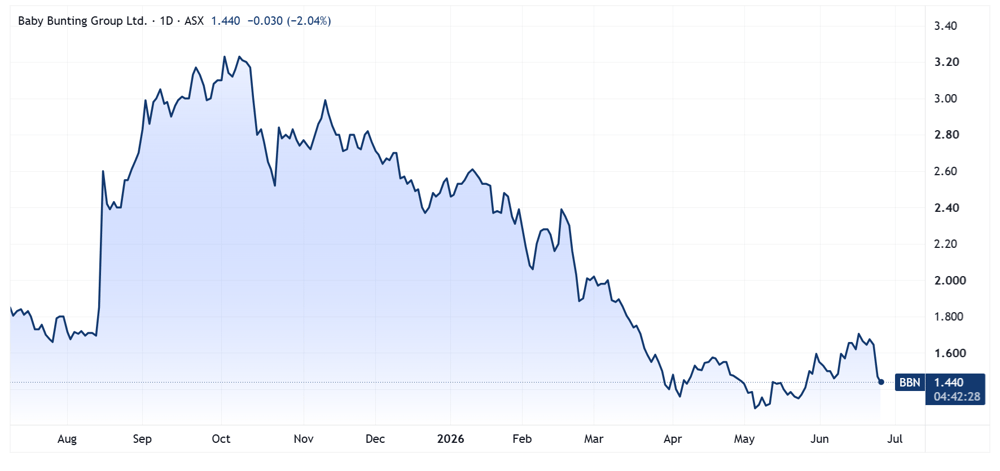
On Wednesday, shares in Baby Bunting (BBN) tumbled 10.6% after the company cut its FY26 sales and net profit expectations.
FY26 NPAT now seen at $16.0-17.0m, down ~11% on prior guidance of $17.5-19.5m and 3% below market expectations of $17m
FY26 comparable store sales growth now ~3.5% vs. prior guidance of 5-7%
CEO comment: "The three RBA cash rate rises in the second half, together with higher fuel prices, weighed on consumer spending and added to our distribution costs. Sales across our non-refurbished store network did not meet plan over the last seven weeks, driven by softness in prams and car safety categories relative to expectations."
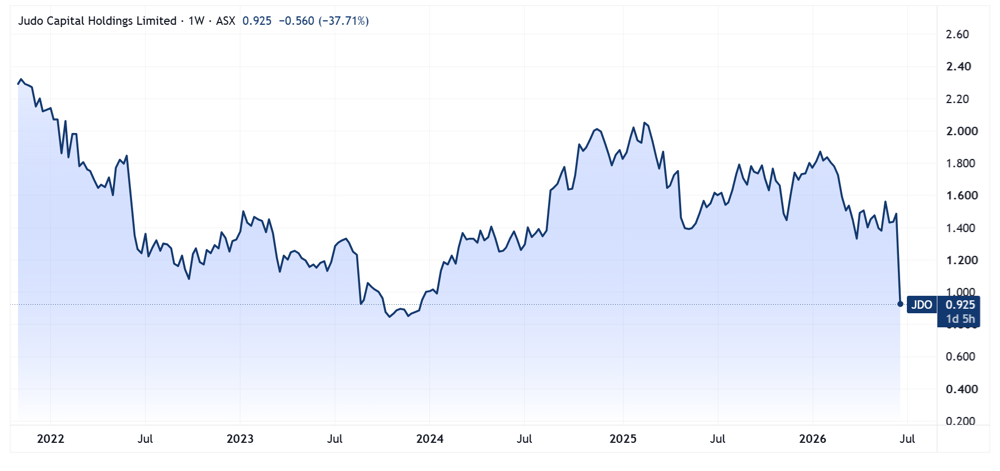
Today, Judo Capital (JDO) cratered 45% after downgrading both FY26 and FY27 expectations.
FY26 PBT guided to $163-169m, down from prior lower-end guidance of $180-190m and below ests of $180.7m (8% miss at midpoint)
FY27 PBT guided to $210-220m, well short of ests of $255.1m (16% miss at midpoint)
CEO comment: "We continue to see strong underlying momentum in the business. Recent credit outcomes have been driven by a small number of customers, who we are actively working with. These exposures have deteriorated subsequent to the customer-by-customer review undertaken in the third quarter and reflect recent, borrower-specific developments."
Worley (WOR) also doubled the earnings drag it expects from the Middle East conflict this morning, with the stock down around 8.5% at the time of writing.
Adverse impact to FY26 underlying EBITA now estimated at up to $60m, vs. prior guidance of $30-40m
Middle East conflict continues to disrupt existing projects, though no cancellations have occurred
Customers continue to delay the start and award of new projects
Stronger Australian dollar in H2 estimated to translate into a $50m hit to FY26 underlying EBITA
Key takeaways
#1 Things can get worse. Baby Bunting was already down around 48% since last October, and the de-rating had brought its trailing price-to-earnings down from almost 50x to 32x (prior to the selloff). Even on the downgraded NPAT guidance, Baby Bunting was trading at a forward PE of 13.5x. Just because a stock is down heavily doesn't mean it can't fall further.
Baby Bunting price chart (Source: TradingView)
#2 Not a time for high expectations. Judo Capital is a stock loved by many for the significant growth runway in the SME market, where the company has a mere ~2% market share.
On 24 April, Judo tempered its FY26 profit before tax guidance towards the lower end of $180-190 million, though reaffirmed other key metrics like net interest margins and cost-to-income. The stock briefly dipped 5.0% on the day, but managed to finish the session up 1.4%. Even after a small setback, every analyst under the sun, including Morgans, CLSA, JPMorgan, Goldman Sachs and more, was Buy rated, with an average target price of $2.14.
"While we recognise rising credit quality risks, we believe risks are now partly reflected in prices. High provisions should support Judo through a modest credit cycle," Macquarie analysts said in a note dated 24 April.
But then you get a day like this, where Judo trades like a meme coin and analysts will likely have a busy day of hosing down earnings expectations.
Judo price chart (Source: TradingView)
The bottom line
The read-through from Judo, a major SME lender, is not a good look for the Australian economy. Its 24 April update noted higher provisions for expected credit losses in "sectors more sensitive to fuel prices and broader economic deterioration, including agriculture, construction, retail trade, manufacturing and transport."
Fast forward to today and you have a material FY26-27 downgrade tied to "specific provision increases for three exposures across different sectors." So if an SME lender has to keep raising provisions, what does that tell you about the state of the economy?
So brace for a volatile confession season, one that will look nothing like last year, when the market was pushing record highs and valuations were rather frothy. Plenty of stocks are now down 20-30% over the past twelve months, and earnings expectations are finally starting to fall, which clears the way for companies to beat a lower bar. But the path of least resistance still looks lower, against a backdrop of hawkish central banks, sticky inflation and a weakening macro picture.
The good news is the dust eventually settles. Much like the 2022-23 rate hike cycle, stocks are forward looking and tend to bottom well before earnings do. The question now is whether this is the worst of it, or whether there's another leg down to come.